Supply Chain Control Tower with AI Agents
Many companies have long invested in their supply chains. Dashboards were built, control towers launched, alerts configured, and data from ERP, WMS, TMS, and planning systems began to be consolidated. Yet after all that, operations teams often find themselves in the same place: they see problems faster, but they still solve them the same way as before.
This is the limit felt by many supply chain teams. Traditional control towers do provide better visibility. They can show that a shipment is late, stock is running low, a supplier is having issues, or demand has spiked. But after that notification appears, humans still have to find the root cause, compare alternative actions, contact relevant parties, check the impact on cost and service levels, and coordinate execution across functions. All of this is done manually, often under tight time pressure.
The gap between seeing an exception and taking action is where the biggest costs hide in modern supply chains. This is especially true when companies face a combination of demand volatility, supplier disruptions, inventory imbalances, fragmented logistics networks, and data scattered across many systems. The control tower team can see everything, but coordination remains slow.
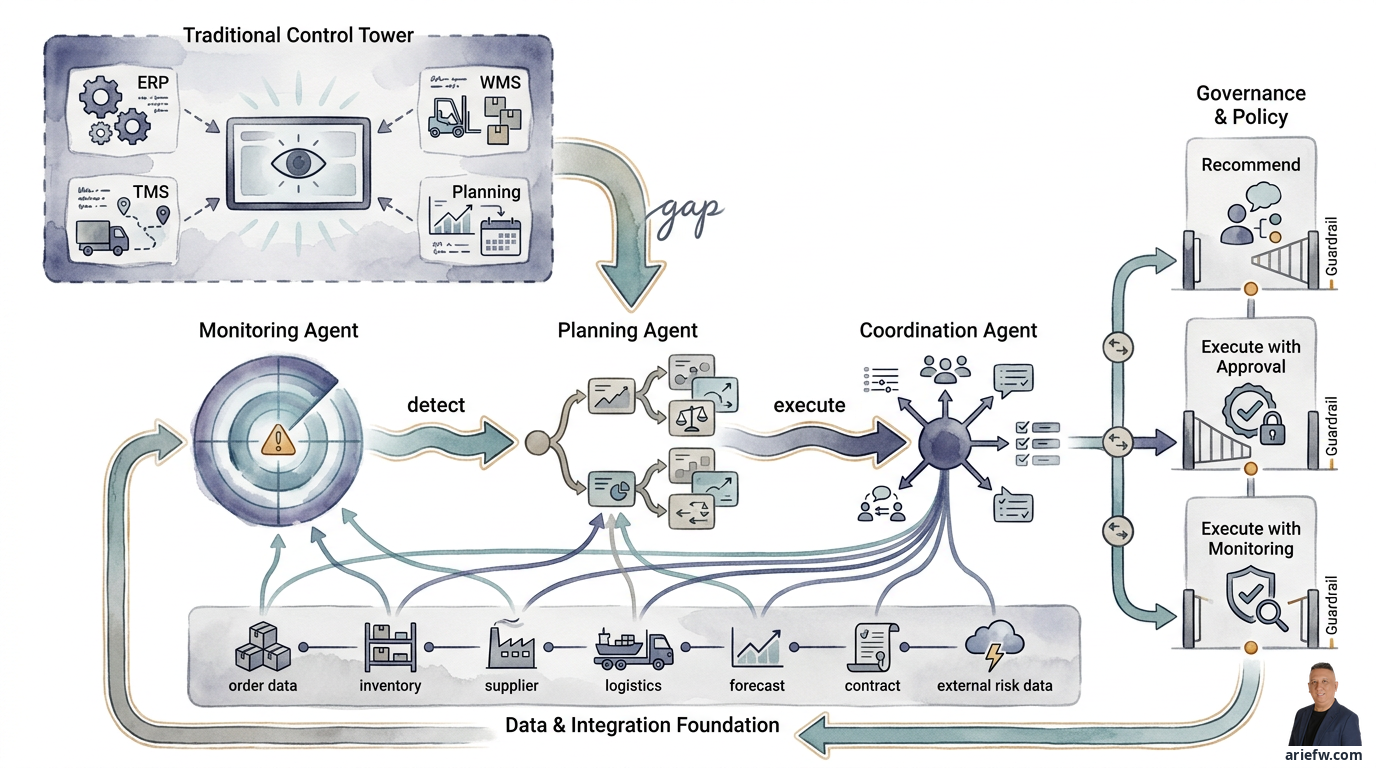
This is where agentic AI offers a more fundamental change. It's not just about adding a chatbot to an existing dashboard. It's about transforming the control tower from a visibility tool into a system that helps orchestrate responses. Agents can detect exceptions, assess response options, prepare cross-functional coordination, and, under certain conditions, execute limited actions within clear boundaries.
Why Dashboards Alone Are No Longer Enough
Today's supply chain is no longer a stable, linear chain. It's more like a constantly moving network, with interconnected dependencies among suppliers, factories, warehouses, carriers, distributors, and sales channels. A problem in one area quickly propagates to another, and its impact is often not visible until it's too late.
Several problem patterns recur frequently. Demand volatility causes forecasts to change rapidly due to promotions, weather, or market shifts. Planning teams often know there's a deviation but lack a fast mechanism to translate it into operational action. Supplier disruptions come from raw material delays, quality issues, or geopolitical events. The challenge isn't just detecting the risk, but deciding what to do: find a substitute, change allocation, or revise the production plan. Inventory imbalance occurs when one location has excess stock while another faces shortages. Total inventory might look safe, but service levels suffer because the stock is in the wrong place. Data fragmentation means orders are in the ERP, inventory in the WMS, shipments in the TMS, forecasts in the planning system, and supplier status in a portal or email. The control tower team has to manually piece this context together every time there's a problem.
As a result, many control towers stop at the level of situational awareness. They provide better dashboards, but they don't reduce the coordination burden. Teams still have to open multiple systems, send numerous emails, and run mini war rooms for every significant exception. For companies with complex supply chain networks, this isn't enough. What's needed isn't just a single screen that consolidates data, but a mechanism for faster, more disciplined action.
Three Types of Agents Transforming the Control Tower
An agentic control tower is an evolution from a passive dashboard to an active operations layer. It doesn't replace planners, logistics leads, or supply chain managers. But it takes over a large portion of the work that has been repetitive, cross-system, and heavily dependent on fast coordination. In practical terms, the most useful pattern typically consists of three types of agents: monitoring agents, planning agents, and coordination agents.
Monitoring Agent: Detecting Exceptions Earlier and with More Context
The monitoring agent continuously reads operational signals and transforms them into meaningful exceptions. It doesn't just tell you a shipment is late; it provides deeper context. For example, a shipment is late for a high-priority customer, critical component inventory will drop below threshold before replenishment arrives, a specific supplier shows a recurring pattern of delays, or a demand spike for a particular SKU threatens to disrupt regional allocation.
The difference from traditional alerts lies in context. Standard alerts are often too numerous and too shallow. A monitoring agent should help answer important questions: Is this exception important? Who is affected? When will the impact occur? Is this a new pattern or a repeat of an old problem?
For example, a consumer goods company sees a delay in an inbound raw material shipment. A standard dashboard simply flags that the ETA has slipped by two days. A monitoring agent can go further by linking that shipment to the production schedule, on-hand inventory, open customer orders, and account priority. The result isn't just an alert, but a warning that this delay could potentially disrupt order fulfillment for a strategic customer within the next 72 hours.
Planning Agent: Evaluating Alternative Responses
Once an exception is detected, the next problem is choosing an action. This is where the planning agent comes in. It doesn't have to be a full-fledged optimizer that takes over all supply planning. A more realistic initial role is to prepare response options based on available data and policies.
For a single exception, the planning agent can evaluate various alternatives. It might consider expediting a shipment, rebalancing inventory between locations, substituting a supplier or material, adjusting a forecast or allocation, rescheduling production, or changing order fulfillment priorities. Importantly, the agent doesn't just give one answer. It should present clear trade-offs: the impact on cost, service level, inventory, and whether the action violates any contracts, policies, or capacity constraints.
In a manufacturing company, for instance, a component from a key supplier is delayed. The planning agent can compare several options: expediting the shipment from the same supplier at an additional cost, diverting some volume to an already-approved alternative supplier, transferring stock from another plant, or adjusting the production sequence to minimize the impact on service levels. Each option has different consequences, and the agent can present them transparently.
This is crucial because supply chains rarely have perfect solutions. There is almost always a trade-off between cost, speed, and risk. The planning agent helps the human team see these choices more clearly before making a decision.
Coordination Agent: Driving Execution Across Functions
Many supply chain exceptions don't fail because the company doesn't know what to do, but because coordination is too slow. The coordination agent helps close this gap. Once an option is selected or recommended, the agent can prepare communication to suppliers, create tasks for the warehouse or logistics team, notify sales or customer service, open approval workflows, update status in relevant systems, and gather confirmations from the parties that need to act.
If the decision is made to rebalance inventory from warehouse A to warehouse B, the coordination agent can create a transfer task, send instructions to the warehouse, inform the transport planner, update the estimated availability for the sales team, and monitor whether the step is actually executed. In a more mature design, the coordination agent can also act as a bridge between the control tower and shared services or a Global Capability Center (GCC) managing global supply chain operations. This is important for multinational companies that need a 24/7 response rhythm.
Example End-to-End Flow
Imagine a regional distributor facing a sudden demand spike for a specific SKU. The monitoring agent detects the order surge that doesn't match the forecast and sees that stock at two main distribution centers will run out sooner than planned. The planning agent then evaluates options: transfer stock from another DC, expedite inbound shipments, or limit allocation for certain channels. The coordination agent prepares a recommendation for the planner, opens an approval for options with cost implications, and once approved, sends tasks to warehouse, transport, and sales operations. The human team focuses on priority decisions and truly ambiguous exceptions, not on data gathering and administrative follow-ups.
This is the key shift: the control tower is no longer just a place to see problems, but becomes an exception resolution engine.
Data and Integration: The Foundation That Determines Agent Quality
Supply chain agents are only as good as the data and integration that support them. This is not a domain that can be sustained by SOP documents and chat interfaces alone. Agents need very concrete operational context. At a minimum, agents typically need access to order data, inventory data, supplier data, logistics data, forecast and planning data, contract and policy data, and external risk signals such as weather, geopolitics, or port congestion.
Integration with core systems becomes the critical path. In an enterprise context, integration usually must cover the ERP for orders, procurement, financial impact, and master data; the WMS for inventory and warehouse execution; the TMS for shipments and transport events; supplier portals for supply status and communication; and the demand planning system for forecasts and scenario planning. Without this integration, the agent will only be an analytics layer offering generic advice. That's still useful, but not enough for a truly operational control tower.
Data latency is also critical. Supply chain is a time-sensitive domain. Data that is correct but late can be as bad as data that is wrong. If inventory updates lag by a few hours, the agent could recommend a rebalance that isn't actually needed. If shipment ETAs aren't updated in time, the agent could be late in triggering mitigation. If forecast refreshes are too slow, a new demand spike won't be factored into the calculation. Therefore, companies need to honestly assess which data needs to be near real-time, which data can be batch-processed, and which decisions should not be made if data freshness doesn't meet the requirements.
Master data quality is not a minor administrative issue. Many supply chain agent failures will be rooted in poor master data: inconsistent SKU mapping, unsynchronized locations across systems, ambiguous supplier hierarchies, different units of measure, or non-uniform definitions of available inventory. In a traditional control tower, these problems are often masked by human intervention. In an agentic control tower, they will directly manifest as incorrect recommendations or faulty coordination. Before pursuing high autonomy, companies need to ensure that their product data for the supply chain is stable enough and has a clear owner.
Governance: Supply Chain Agents Must Not Act Without Limits
Supply chains often seem operational, but many decisions have significant financial, contractual, and reputational impacts. Therefore, governance for supply chain agents must be designed seriously.
The healthiest pattern is usually not to give agents full execution rights immediately, but to distinguish three levels of action. The first level is recommend, where the agent detects an exception and presents action options along with their impacts, while a human makes the decision. This is suitable for supplier switches, changes in customer allocation, revisions to material forecasts, or decisions involving commercial trade-offs. The second level is execute with approval, where the agent prepares the action but execution only proceeds after human approval. This is suitable for expedites with additional costs, inventory transfers between locations, changes in fulfillment priority, or formal communication to strategic suppliers. The third level is execute with monitoring, where the agent can perform low-risk actions within clear policy boundaries, and humans monitor the outcomes and exceptions. This is suitable for internal notifications, creating follow-up tasks, updating control tower status, or automatic escalation to the right role.
This approach helps companies avoid two extremes: agents that are too passive to provide value, or agents that are too autonomous before controls are ready.
Policies for supply chain agents cannot be based solely on technical thresholds. They must consider at least four dimensions: financial impact, customer priority, contractual obligations, and compliance and regulation. The agent might see an alternative supplier available, but if the material is in a regulated industry, switching suppliers cannot be treated as a routine operational decision. There must be a clear policy gate.
If a company wants to manage supply chain agents seriously, metrics must shift from activity to outcome. Relevant metrics include forecast accuracy (to see if sensing and adjustment help), exception resolution time (to measure speed from detection to action), inventory availability or service level (to see the operational impact), expedite cost reduction (to assess if the agent helps reduce costly responses), override rate (to see if agent recommendations are trusted), and false positive alert rate (to ensure the monitoring agent isn't creating noise).
When This Pattern Is Not Appropriate
An agentic control tower is not a universal answer. There are conditions where companies should hold back. If basic processes are not yet stable—such as weak planning discipline, chaotic master data, and unclear exception ownership—an agent will only accelerate the confusion. If core integrations are not ready—without reliable access to ERP, WMS, TMS, and planning systems—the agent will stop at the insight level, not orchestration. If the organization is not ready to accept policy-driven decisions—because many companies still rely heavily on individual heroics in the supply chain—the agent will struggle to have a consistent operational role. If cross-functional governance does not exist—because supply chain exceptions almost always touch procurement, manufacturing, logistics, sales, and finance—the agent will produce recommendations that are locally correct but cannot be executed organizationally.
Workforce Implications: The Control Tower Team Will Change
When agents enter the control tower, human roles don't disappear, but they shift. The control tower team will increasingly focus on truly ambiguous exceptions, cross-functional trade-off decisions, negotiations with suppliers or customers, root-cause analysis, and improving agent policies or parameters. Conversely, tasks like monitoring alerts one by one, gathering data from multiple systems, preparing status updates, and chasing cross-team confirmations will increasingly be taken over by a combination of monitoring, planning, and coordination agents.
This means supply chain supervisors and operations leads need to learn how to manage a human-agent team, not just a human team. They need to read new metrics, understand when an agent can be trusted, and know when to lower or raise the level of autonomy.
Questions for CIOs, COOs, and Transformation Leaders
Does your company's current control tower truly help the organization act faster and more disciplined, or does it merely let everyone see the same problems without a sufficient coordination engine to solve them? If the answer is still the latter, then the next agenda isn't adding another dashboard. It's redesigning the control tower as an agentic orchestration layer for the supply chain.