Orchestrator Agent vs Task Agent
Imagine your finance team is trying to close the books at month-end. Data is scattered across the ERP, spreadsheets, and emails. There are journal anomalies to analyze, reconciliations still pending, and tax policies to review. The team wants AI to help accelerate this process, but a direct question arises: is one agent enough to handle everything? Or do you need several agents with different roles?
This is a fair question. Many companies that already have AI pilots in several functions are realizing that a single chatbot or copilot isn't enough to handle complex enterprise work. A process like finance close, customer complaint handling, or procurement intake consists of various types of activities: some are coordinative, some are transactional, some require domain knowledge, and some must adhere to specific controls.
The problem is, when companies rush to ask "which AI model should we use?" or "which agent platform should we buy?", they often skip a more fundamental question: what kind of agent do we actually need?
Why a Single Agent Isn't Enough
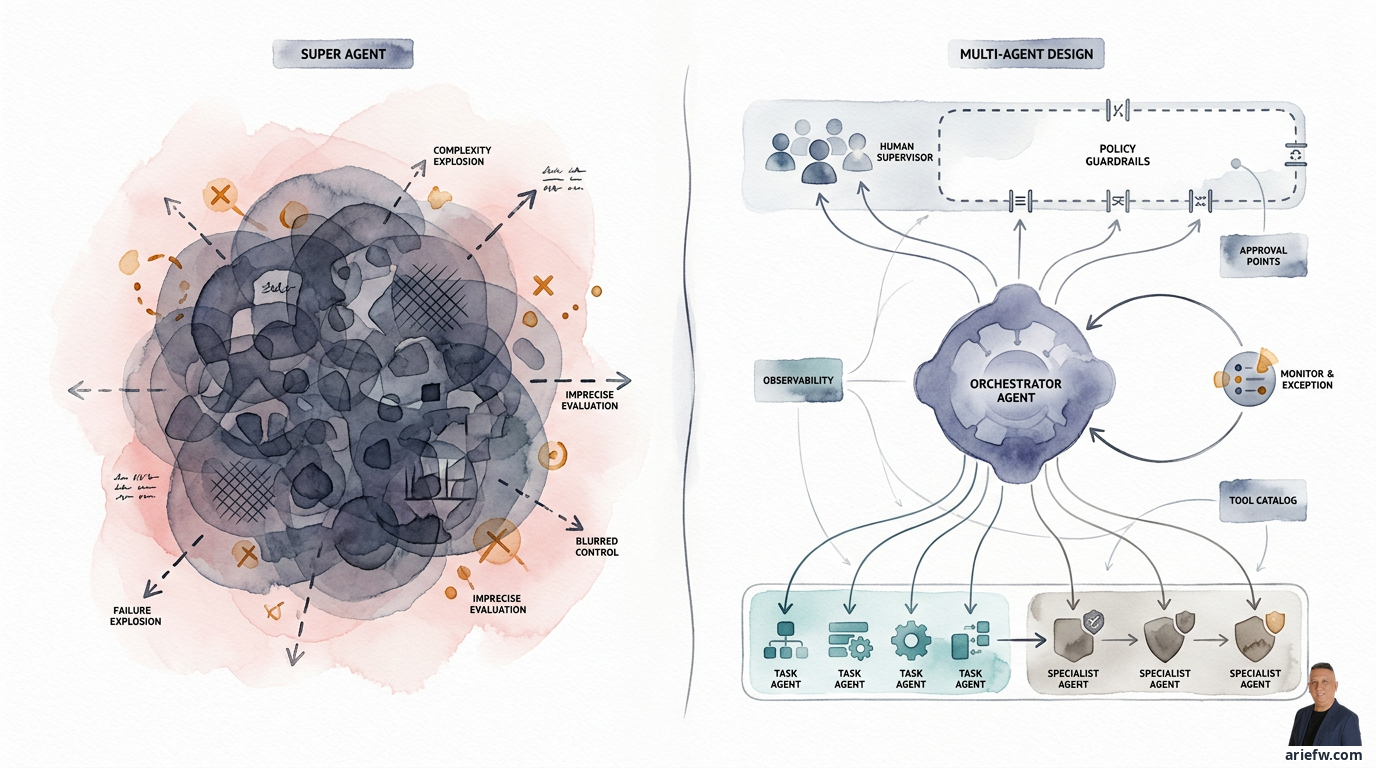
In early discussions about AI agents, many people imagined a single "super agent" that receives a high-level goal and then solves everything on its own. This vision is compelling for demos, but it rarely fits enterprise operations. The reason is simple: enterprise work is not homogeneous.
Consider the invoice exception resolution process. There are steps for reading documents, extracting data, matching against purchase orders, checking purchasing policies, determining if approval is needed, and, if there's an issue, escalating to a human. Combining all of this into a single agent creates three problems at once.
First, complexity quickly explodes. The more roles you pile onto one agent, the harder it becomes to define its scope. The agent must understand the goal, choose the sequence of work, call tools, interpret policies, handle exceptions, and produce domain-specific output. Technically, it might be possible to build, but from an enterprise perspective, it becomes difficult to test, explain, and audit.
Second, control becomes blurred. If one agent does everything, who sets the boundaries of its authority? Can it only analyze, or can it also execute? Can it choose its own tools? Can it change the process sequence? In regulated domains, these questions cannot be left implicit.
Third, performance evaluation becomes imprecise. When output is poor, the company needs to know the source of the problem. Did the agent break down the task incorrectly? Choose the wrong tool? Misinterpret a tax rule? Fail to extract invoice data? With a monolithic design, diagnosis is difficult. Conversely, if roles are separated, evaluation becomes much sharper.
Therefore, distinguishing between agent types is not just a technical term. It is a design tool for reducing complexity and increasing control.
A More Useful Mental Model: Agents as a Digital Work Team
The most practical way to understand this difference is to imagine an agentic system like a work team. Some act as workflow managers, some as executing staff, some as subject matter experts, and humans retain decision-making authority at sensitive points.
An orchestrator agent is like an operational project manager. It doesn't need to be an expert in every domain, but it must know how to break down work, determine the sequence, choose who does what, monitor status, and handle exceptions.
A task agent is like an executing staff member handling a specific unit of work. It is designed to complete a task with relatively clear inputs, outputs, and scope. For example, reading an invoice and extracting key fields, drafting a follow-up email, or calling an API to check an order status.
A specialist agent is a task agent with domain depth. It still performs a specific task, but brings deeper knowledge. For instance, a tax specialist agent to review transaction treatment, or a compliance specialist agent to check adherence to spending policies.
A human supervisor retains decision-making or validation at sensitive points, especially where risk is high or regulations are strict.
Orchestrator Agent: The Workflow Coordinator, Not the Expert in Everything
The orchestrator agent is responsible for workflow coordination. It receives a higher-level goal, breaks it down into smaller steps, determines the sequence of work, selects the relevant agent or tool, monitors status, and manages exceptions.
The orchestrator's role typically includes five core functions. First, breaking down the goal into executable tasks. For example, in procurement: the high-level goal is to complete a purchase intake until it's ready for processing. The orchestrator breaks the work down into classifying the request type, checking category policies, validating the vendor, determining the approval path, and creating a draft PO or escalating if there's an exception.
Second, determining the sequence of work. In some processes, the order of steps is critical. In vendor onboarding, it doesn't make sense to activate a vendor before compliance documents are verified. In finance close, journal anomaly analysis must happen before final commentary is prepared. The orchestrator maintains this sequencing.
Third, selecting the right specialist or task agent. The orchestrator doesn't have to be an expert in tax, contracts, or supply chain. Its value lies in its ability to choose who should do what. For example, it might call a tax specialist agent to review VAT treatment, call an OCR task agent to read an invoice, call an ERP API to check a PO status, and then combine the results.
Fourth, monitoring status and handling exceptions. Enterprise workflows rarely run smoothly from start to finish. There are missing data points, failing tools, conflicting policies, or low confidence scores. The orchestrator must know when to proceed, when to try an alternative path, when to request approval, and when to escalate to a human.
Fifth, assembling a clean final output or handoff. In customer operations, for instance, the orchestrator can combine identity verification results, order status, refund policies, and interaction history into a single final response or escalation package ready for a supervisor's review.
Enterprise Example: Finance Close
Imagine the record-to-report process during a month-end close. An orchestrator agent can monitor which entities haven't completed reconciliation, call a task agent to pull ledger data and exceptions, call a specialist agent to analyze journal anomalies, prioritize items based on materiality and deadlines, and then send specific items to the controller for approval. Here, the orchestrator isn't acting as an accountant. It is the workflow coordinator for the close process.
Key Risk of the Orchestrator: Over-Autonomy
Because the orchestrator sits at the center of coordination, its biggest risk is too much autonomy. Without constraints, the orchestrator could choose a process path that doesn't comply with policy, call tools it shouldn't use, execute cross-system actions without proper approval, or keep trying to solve a problem when it should stop and escalate.
In an enterprise, the orchestrator should not be allowed to operate as a free manager. It must work within clear boundaries: a policy engine defines what actions are permissible, constraints define which tools can be called, approval points determine when a human must step in, and observability ensures every step can be traced.
Not every use case requires a sophisticated orchestrator. If the process is very simple, linear, and consists of only one or two deterministic steps, adding an orchestrator can actually increase cost, latency, and complexity. For tasks like extracting data from a standard invoice or drafting a simple email, a single task agent is often sufficient.
Task Agent and Specialist Agent: Focused Executors
If the orchestrator is the workflow coordinator, then the task agent is the executor of a narrower unit of work. It is designed to complete a specific task with relatively clear inputs, outputs, and scope. Examples include reading an invoice and extracting key fields, drafting a follow-up email, calling an API to check an order status, performing simple matching between PO, GR, and invoice, or summarizing an incident ticket from logs and case history.
Task agents are generally easier to build and easier to test because their scope is narrow. In many enterprise programs, task agents are the most realistic entry point for initial production.
Specialist Agent: A Task Agent with Domain Depth
Beyond the task agent, there is a category that is often very useful: the specialist agent. It still performs a specific task, but brings deeper domain knowledge. Examples include a tax specialist agent to review transaction treatment, a procurement compliance specialist agent to check adherence to spending policies, a supply chain specialist agent to analyze shipping exceptions, a software testing specialist agent to generate and validate test cases, or a legal ops specialist agent to flag contract clauses that deviate from standards.
The key difference is not that it is smarter, but that its scope of knowledge is different. A specialist agent is built with more specific context, rules, and evaluation criteria for a particular domain.
In an enterprise, trust is built not from claims of intelligence, but from clear limitations. A specialist agent is easier to trust because its domain is narrow, the expected output is more defined, the relevant data and policies are easier to curate, and quality evaluation is more concrete. For example, it is easier to test an agent whose task is "check if an invoice meets a specific tolerance policy" than an agent whose task is "manage the entire source-to-pay process."
Enterprise Example: Customer Operations
In a customer complaint handling process, a company might have several task and specialist agents. There is a task agent for identity verification, a task agent for pulling order and ticket history, a policy specialist agent to determine refund eligibility, a sentiment or risk specialist agent to assess if the case has potential for reputational escalation, and then an orchestrator that combines everything and determines the resolution path.
With this design, each component can be tested separately. If a refund is given incorrectly, the company can trace whether the problem was with the policy specialist, the data retrieval, or the orchestration decision.
Trade-off: Too Many Agents is Also Dangerous
While modularity is important, companies also need to avoid excessive fragmentation. If every tiny step is made into a separate agent without a strong reason, the system becomes difficult to operate. Dependencies increase, latency grows, debugging becomes complex, ownership becomes unclear, and orchestration costs rise.
Therefore, agent separation must follow business logic and control needs, not just technical preference. A simple principle: separate agents when the separation improves control, reusability, or evaluation; don't separate just because you can.
The Most Relevant Multi-Agent Design Patterns
Once you understand the roles of orchestrator and task/specialist agents, the next question is how they work together. In an enterprise, there are several common and useful design patterns.
Sequential Pattern: For Linear Workflows
The sequential pattern is suitable when work follows a relatively fixed order. Each agent completes a specific step, and the result is passed to the next step. Good examples include employee onboarding, invoice processing, vendor onboarding, simple claims, or standard service requests.
In invoice processing, the sequence might look like this: a task agent reads the invoice, a task agent checks data completeness, a specialist agent performs matching against PO and policy, the orchestrator decides if the invoice can go straight through or needs escalation, and then, if necessary, a human approves specific exceptions.
The advantage of this pattern is its simplicity, ease of business understanding, and relative ease of auditing. The disadvantage is that it is less flexible for cases requiring multiple simultaneous perspectives.
Parallel Pattern: For Multi-Perspective Analysis
The parallel pattern is suitable when a single case needs to be assessed from several viewpoints simultaneously. The orchestrator sends the same context to multiple specialist agents and then combines the results. Good examples include contract review, vendor risk assessment, operational policy change decisions, or sensitive customer complaint handling.
In an enterprise contract review, a single draft contract can be sent in parallel to a legal specialist agent for clause deviations, a risk specialist agent for operational exposure, a finance specialist agent for commercial implications, and a compliance specialist agent for regulatory obligations. The orchestrator then compiles a unified summary and highlights areas needing human decision.
The advantage of this pattern is richer analysis and faster cross-functional review. The disadvantage is that it requires greater discipline in reconciling potentially conflicting results.
Supervisor Pattern: For Regulated or High-Risk Domains
The supervisor pattern adds a validation layer before an action is executed. The supervisor can be a human, or a supervisory agent that only checks compliance with specific rules before an action is taken. This pattern is highly relevant for payments, master data changes, credit decisions, sensitive HR actions, or IT remediation with broad impact.
In a procurement exception, the orchestrator can coordinate policy checks, vendor risk, and budget availability. However, before a high-value PO is issued or a new vendor is activated, a human supervisor or control agent must validate whether approval thresholds are met, whether mandatory documents are complete, whether there is a conflict of interest, and whether the purchasing path is compliant with policy.
The advantage of this pattern is higher trust and control. The trade-off is clear: cycle time can be slower, and the approval design must be careful not to reintroduce all the old bottlenecks.
Choosing the Right Pattern: Don't Just Chase Autonomy
A common mistake in multi-agent design is assuming the most autonomous pattern is always the best. In an enterprise, what matters more is the fit with the process characteristics. If the process is stable, linear, and high-volume, sequential is usually most efficient. If decisions require multiple domain perspectives, parallel is more appropriate. If risk is high or regulations are strict, the supervisor pattern is almost always necessary. If the process is highly deterministic, an agentic pattern might not even be needed; a standard workflow or traditional automation could be more suitable.
Agent design must follow the company's operating model and risk posture, not the other way around.
Implications for Architecture, Governance, and Workforce
The distinction between orchestrator and task agent is not just a technical design choice. It has direct implications for enterprise architecture, governance, and the workforce.
From an architecture perspective, the orchestrator needs access to workflow status, policies, and a broader tool catalog. Task agents typically need narrower, more specific access. This means identity, permissions, and observability cannot be treated the same way.
From a governance perspective, the orchestrator usually requires tighter oversight because it determines the work sequence and chooses actions. Task agents are better suited for narrow, bounded autonomy. Specialist agents need additional governance on the knowledge sources and policies they use.
From a workforce perspective, the more orchestrators are used, the more important the human roles become as process owners, agent supervisors, policy designers, and exception managers. Meanwhile, task agents tend to shift routine transactional work. This means organizations need to prepare for a role shift from manual execution to supervision, exception handling, and continuous improvement.
Practical Steps to Get Started
After understanding these differences, there are several decisions to make. First, determine whether your use case requires an orchestrator or if a task agent is sufficient. If the process is just a single narrow task, don't force an orchestrator. Second, separate the coordination role from the execution role. Don't let one agent be simultaneously a workflow manager, subject matter expert, and executor without clear boundaries. Third, identify areas that need a specialist agent. Domains like tax, compliance, legal, procurement policy, or supply chain exceptions are usually safer when handled by a specialist agent. Fourth, choose a multi-agent pattern that fits the process characteristics. Fifth, set specific guardrails for the orchestrator. The tools it can call, escalation conditions, approval points, and logging must be stricter than for a regular task agent.
To assess your company's readiness, use the following questions. Have you mapped which workflows need cross-step coordination and which only need task automation? Do you have a clear definition of the roles of orchestrator, task agent, and specialist agent? Do you know which tools, APIs, and data each type of agent is allowed to access? Do you have explicit approval points for high-risk actions? Can you evaluate the output of each agent separately, not just the final system result? Do you have observability to see which agent failed, at which step, and why? Have the business owner, technical owner, and risk owner for the main agents been assigned?
There are several red flags that indicate this topic is not ready for scale or needs additional governance. If the company is building a single super agent for an entire function without clear role separation. If the orchestrator is given broad access to many systems without a policy engine and approval thresholds. If task agents don't have well-defined inputs and outputs. If specialist agents use a knowledge base that is not curated or permission-aware. If there is no way to distinguish whether a failure came from orchestration, a tool call, or domain logic. If every team is building their own agent taxonomy without an enterprise standard.
Understanding the difference between an orchestrator agent and a task agent is a fundamental step to avoid two major mistakes at once: building an agent that is too large to be trusted, or building too many small agents without a clear coordination model. In an agentic enterprise, the design of digital labor roles must be as precise as the design of human work structures. The next question for CIOs, COOs, CHROs, and transformation leaders is: does your architecture already distinguish between agents that coordinate workflows and agents that only execute tasks? In your core business processes, which parts actually need intelligent coordination, and which parts can be automated narrowly? If task agents take over routine work, which human roles need to be strengthened for supervision and exception handling? Does your agent design follow the value stream and business controls, or is it still following the boundaries of technology silos?