Build, Buy, Partner, or Borrow: AI Agent Sourcing Strategies
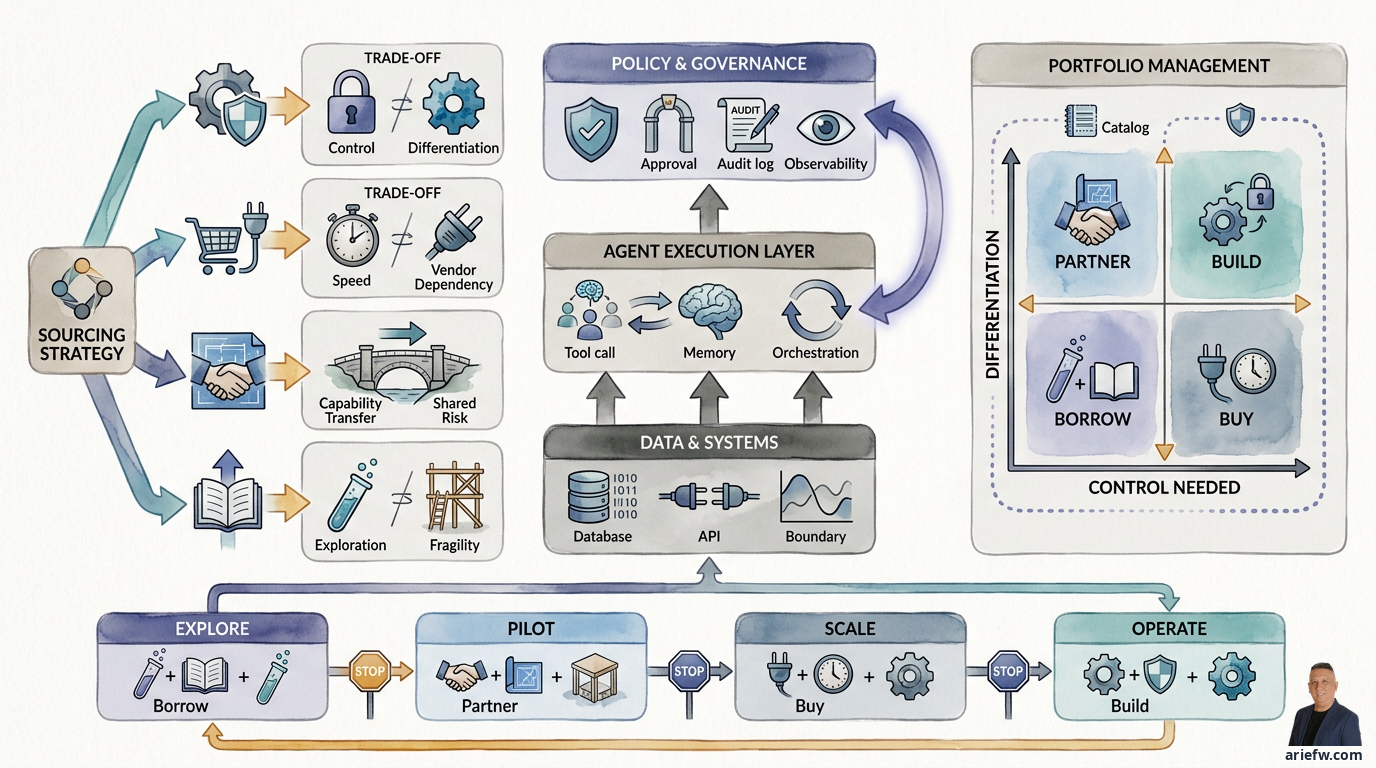
Imagine you are a chief technology officer or a head of a business function. Your team is already seeing the potential of agentic AI. Perhaps there's a promising chatbot pilot in customer service, or the finance team is experimenting with an agent to assist with month-end closing. The question that quickly emerges is no longer "do we need agents?" but rather "where do we get these agent capabilities from?"
Should your team build everything from scratch? Simply buy a ready-made solution from a vendor? Or perhaps partner with an external firm? Or just borrow open-source components to move fast?
This looks like a technology decision, but it runs much deeper. Your sourcing choice will determine how quickly business value can be realized, how much control the company has over its data and processes, and how easily these agents can be integrated and managed in the future. Without a clear framework, companies risk falling into vendor lock-in or, conversely, ending up with a chaotic, hard-to-manage agent ecosystem.
Why This Decision Is So Complex
Sourcing decisions for AI agents differ from typical software decisions. An agentic capability can manifest in many forms simultaneously. It could be a feature embedded in the SaaS you already use, an add-on from a specific platform, an open-source framework assembled by an internal team, or a custom solution built on top of company data and models.
Take customer operations as an example. A company might buy a ready-made customer service agent from a CRM vendor. At the same time, an internal team builds an orchestration layer to connect the CRM with order systems and company policies. They also borrow open-source components to experiment with memory and data retrieval. Then they engage a partner to help run initial operations while transferring knowledge to the internal team.
All of these choices can be valid. The problem is that without a clear decision framework, companies quickly fall into three common traps.
First, premature vendor lock-in. Many agentic solutions offer fast time-to-value, but if a company cedes too much process logic, context data, and oversight to a single vendor, the cost of switching later can be prohibitive. This is especially dangerous for workflows that become core to how the company operates.
Second, a fragmented agent ecosystem. If every business function buys or builds its own agents independently, the company ends up with inconsistent agent identities, overlapping tool integrations, different evaluation standards, and non-uniform governance. The result is not a company driven by a unified agent strategy, but agent chaos that is difficult to control.
Third, slow time-to-value. On the other hand, an obsession with building everything in-house often keeps organizations stuck in the foundation phase for too long. Teams get busy building generic frameworks and platforms, but business use cases never truly make it to production. In a fast-moving market, this is just as dangerous as vendor dependency.
Therefore, agent sourcing must be treated as a portfolio decision. The main question isn't "which option is best in general," but rather: does this capability truly differentiate our business? How sensitive are the data and decisions it touches? How quickly does value need to materialize? And how much control do we need in the long term?
When Building In-House Is the Right Choice
The build approach makes the most sense when an agent touches a capability that is a source of company differentiation, is very close to proprietary data, or requires complete control over its behavior and lifecycle. This typically occurs in three types of areas.
First, capabilities that are core to competitive advantage. If an agent will execute logic that fundamentally defines how the company competes, buying it off-the-shelf is often unwise. Examples include underwriting logic in insurance, proprietary pricing engines in distribution or B2B retail, or domain-specific operational intelligence in supply chains. In such cases, the agent's value lies not just in its AI interface, but in the combination of internal data, decision rules, workflow exceptions, and company-specific operational learning. If all of that is handed over to a vendor, the company risks giving away its differentiation.
Second, capabilities very close to sensitive data or critical controls. Build is more appropriate when an agent touches risk decisions, highly protected customer data, financial control logic, or operational intelligence that must not leave certain boundaries. In finance, for example, an agent that helps with closing analysis might be bought. But an agent that orchestrates the handling of material exceptions, combining internal policies, controller considerations, and audit history, is often safer if built on an internal platform and governance framework.
Third, capabilities requiring deep observability and policy control. Some workflows demand that a company can explain in detail what context the agent used, which tools it called, what decisions it made, and why it stopped, continued, or escalated. If auditability and runtime control requirements are very high, building provides more flexibility to embed a policy engine, approval workflows, observability, evaluation harnesses, and lifecycle management that meet internal standards.
However, build is not automatically the most sophisticated or strategic choice. Build only makes sense if the company has the maturity to support it. At a minimum, building requires strong engineering capabilities, a clear agent platform or at least platform patterns, healthy API integration with core systems, mature data governance, model risk and security reviews, and an operating model for ownership, support, and continuous improvement. Without these, building will only result in prototypes that are difficult to operationalize.
Consider an insurance company wanting to build an underwriting agent for a specific segment. If the agent only answers general broker questions, buying the capability from a vendor might suffice. But if the agent will read submissions, combine claims history, call internal risk models, apply proprietary appetite rules, and prepare underwriting decision recommendations, then building is far more sensible. The primary value lies in the combination of internal data and logic, not just the generative model.
Building is usually not the right choice if the capability is already very common in the market, differentiation needs are low, the company lacks the necessary platform and team, or the business needs quick results to prove value. In such conditions, building often turns into an expensive, slow technology project.
When Buying Makes More Sense
The buy approach is suitable for capabilities that are relatively common, already mature in the SaaS or enterprise platform market, and are not a primary source of differentiation. This often applies to areas like service desk assistants, CRM sales agents, employee self-service agents, knowledge assistants, or workflow agents tightly coupled with a specific SaaS platform.
The advantage of buying is clear: faster time-to-value. The company doesn't need to build everything from scratch. Basic integrations, user interfaces, and some guardrails are usually already available. For organizations wanting to move quickly, this is very attractive.
In IT operations, an agent for summarizing incidents, suggesting knowledge articles, or helping triage tickets on an ITSM platform is often more efficient if bought from a vendor already embedded in that stack. In CRM, a sales agent that helps prepare follow-ups, summarize account activity, or suggest next-best actions is often adopted faster if bought as an embedded capability from the platform the sales team already uses. In HR services, an employee service agent for answering common policy questions usually doesn't need to be built in-house unless the company has very unique needs.
However, speed comes with compromises. The company has more limited control. It may not be able to deeply configure how reasoning is done, how memory is managed, how observability is presented, or how runtime policies are applied beyond the options the vendor provides. Many vendors promise configuration, but not all truly support complex custom workflows. For enterprise processes full of exceptions, this limitation is quickly felt.
Auditability and data boundaries must be seriously examined before buying. The company needs to assess what data goes to the vendor, where context is processed, how logs are stored, whether agent decisions can be explained, and how access controls are applied. For regulated domains, these questions cannot be postponed until after the contract is signed.
An exit strategy must also be clear. If a bought agent becomes a critical part of a workflow, the company needs to know if interaction data can be exported, if configurations and prompts can be migrated, if tool integrations depend on proprietary formats, and what happens if the vendor changes its roadmap or pricing. Without an exit strategy, buying can turn into structural dependency.
Buying is less suitable if the workflow is very unique and full of proprietary logic, the company needs deep control over policy and observability, or the agent will become an orchestration layer across many systems not controlled by that vendor. In such cases, vendor solutions are often good starting points but poor long-term foundations.
When Partnering or Borrowing Is a Healthy Choice
Between build and buy, there are two approaches that are often the most realistic for large enterprises: partner and borrow. Both are useful, but for different purposes.
The partner approach is suitable when the company knows the value pool it wants to pursue but lacks mature implementation patterns or is not yet ready to operate an agentic service itself in the early phase. A partner can play several roles: helping build blueprints and reference architectures, developing the first agents alongside the internal team, operating a managed service for a specific domain, or accelerating industrialization through accelerators and delivery capabilities.
This is often relevant for shared services, global capability centers (GCCs), or functions wanting to move quickly from pilot to operations. A GCC aiming to transform finance operations into an agentic model may not need to build all capabilities in-house immediately. Partnering with a service provider can help design the operating model, build agents for AP exceptions and closing support, set up governance and observability, and then gradually transfer capability to the internal team. This approach makes sense if the goal is not just to have software, but to change how services work.
However, partnering does not mean handing over accountability. Contracts must be clear on IP ownership, data usage, operating model, SLAs, audit rights, and knowledge transfer plans. Otherwise, the company is simply shifting dependency from a software vendor to a service vendor.
The borrow approach typically means leveraging open-source frameworks, reference architectures, starter kits, accelerators, or community components to learn quickly before an official platform is standardized. Borrowing is very useful in the early phase when the company wants to test orchestration patterns, understand tool-calling needs, try out a context layer, or prove a use case without waiting for an enterprise platform decision to be finalized.
For example, a procurement team might want to test an intake agent that reads requests, checks policies, calls contract data, and prepares an approval path. To prove this pattern, the team could borrow open-source components and internal accelerators. If the results are promising, the capability can then be migrated to an official platform with stronger controls.
Borrowing provides speed of learning, but it has clear limits. Component quality and security can vary, long-term ownership is often unclear, open-source dependencies can be hard to manage, and teams can get stuck on prototypes that are never hardened. Therefore, borrowing should be treated as an exploration path, not a reason to delay standardization.
Both partner and borrow are often chosen for speed. Precisely because of this, their governance must be more disciplined. The company needs to ensure clear data boundaries, clear rights for using models and artifacts, no ambiguity on IP from development, that accountability for agent decisions remains with the enterprise, and that there is a transition path from experimentation to formal operations. Without this, the company will move fast in the wrong direction.
The Hybrid Reality: Managing a Mix of Agent Sources
In practice, large enterprises will almost certainly end up with a hybrid agent supply chain. Some agents are built in-house, some are bought from SaaS, some are developed with partners, and some are borrowed for experiments or specific components. This is not a problem. What is dangerous is if this mix grows without a shared architecture and governance.
To manage this hybrid model, companies need several things. First, an agent registry: a catalog describing what agents exist, who the business and technical owners are, where they come from, what data and tools they use, their risk level, and their lifecycle status. Without a registry, there is no healthy way to manage the agent portfolio.
Second, interoperability standards. Agents from different sources must still be able to coexist in the same ecosystem. This requires standards for identity, tool calling, events, logging, observability, and handoffs between agents or to humans. Without this, every agent becomes its own island.
Third, risk classification. Not all agents need the same level of control. A knowledge assistant agent is certainly different from an agent that can trigger actions in an ERP system. The company needs to classify agents based on risk and business impact, then apply proportional controls.
Fourth, shared governance. Regardless of source, all agents entering operations must adhere to the same governance: security reviews, data permissioning, evaluation, approval thresholds, observability, incident management, and decommissioning processes. Sourcing can differ, but enterprise standards must not.
A Healthier Way to Think: Sourcing by Layer
A single use case does not have to use a single sourcing strategy. Often, the best decision differs by layer. For example, buy for a capability embedded in CRM, build for the orchestration and policy layer, partner for initial implementation, and borrow for experimenting with specific context components.
The more mature sourcing question is: which layer is a differentiator? Which layer is already a commodity? Which layer needs acceleration? And which layer is still worth exploring? This approach is far more realistic than forcing a single answer for the entire agentic stack.
Ultimately, a good agent sourcing strategy is not about choosing one side. It is about placing control, speed, and differentiation in the right places. A mature company will not build everything itself, but it will also not blindly buy its future. It will manage agents like a portfolio of enterprise capabilities, with architectural discipline, governance, and accountability commensurate with the importance of the agent's role in business operations.