Workforce Reskilling for the Agentic Enterprise
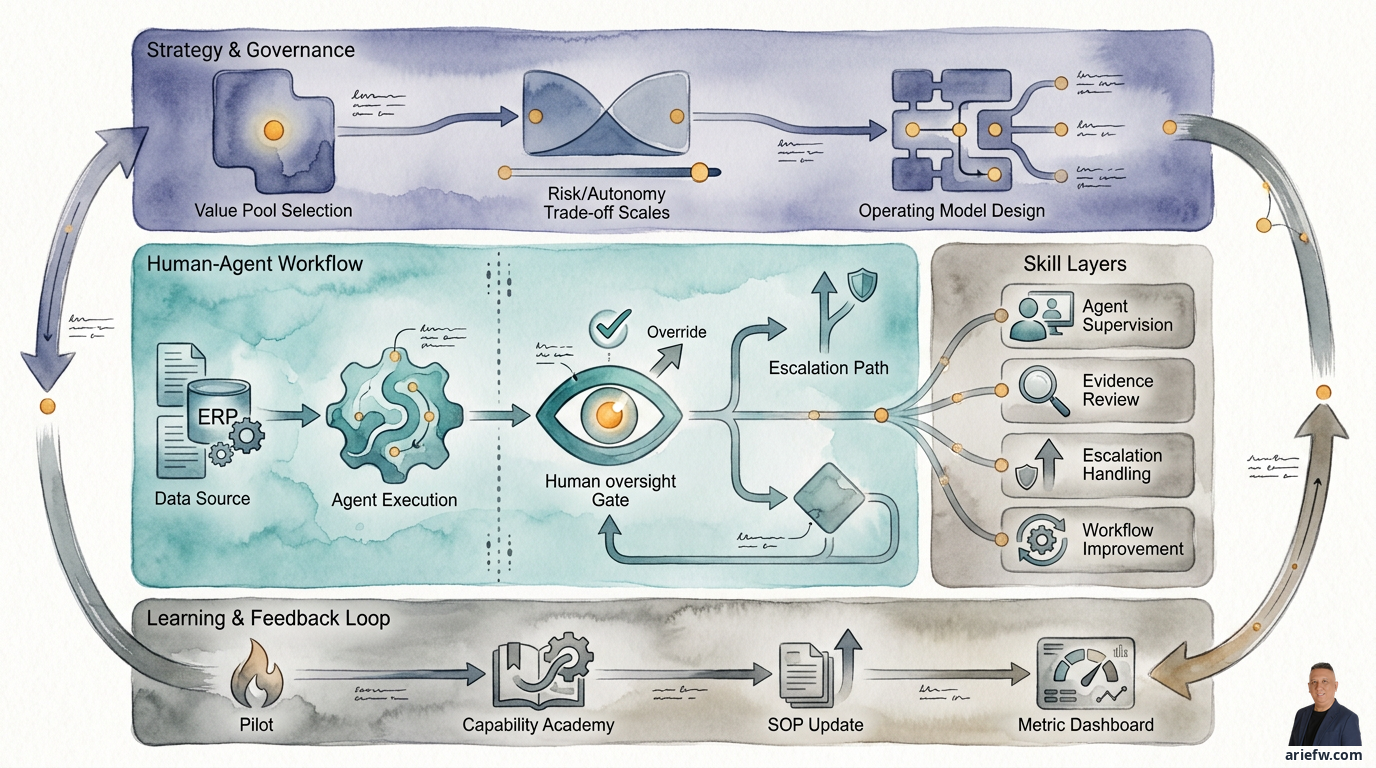
Imagine your finance team has just launched an agent to help with the monthly close process. The agent can pull data from the ERP, draft variance commentary, and flag anomalies. In the first week, results look promising. But in the second week, a controller discovers the agent used data from the wrong period. Not because the agent was broken, but because the initial instructions the team provided weren't specific enough about which data source to use.
Scenarios like this are starting to emerge in many companies. It's not because the technology doesn't work, but because the organization lacks people who know how to work alongside agents, oversee their output, and refine the workflows now run by a combination of human and digital labor.
This is where many companies get it wrong. They assume reskilling for the agentic era simply means generic prompt engineering training or workshops on using chatbots. Yet, when agents start entering real workflows—finance close, procurement intake, customer operations, IT operations, supply chain exception handling, or shared services—the required skill shift runs much deeper. It's not about how to ask an AI questions; it's about how to run operations alongside AI agents.
From Execution to Oversight
Agentic AI will indeed take over a portion of transactional work. Tasks like searching for data across systems, preparing drafts, classifying cases, monitoring queues, or performing administrative follow-ups will increasingly be handled by agents. But this doesn't mean the need for human skills declines. Quite the opposite: demand for specific capabilities rises sharply.
Humans must now fill a more challenging space. They need to assess whether an agent's output is trustworthy, understand when a case needs escalation, handle exceptions that don't fit the pattern, and refine processes so the agent performs better over time. Agentic AI reduces routine work but places a premium on oversight, domain judgment, process design, risk awareness, and feedback discipline.
Four gaps appear most frequently. First, the operational instruction gap. Many employees can ask an AI to create a summary, but they may not be able to give precise instructions within an enterprise workflow context. Poor instructions don't just yield bad answers; they can create rework, misrouting, or misleading recommendations.
Second, the output validation gap. This is the most dangerous. Many people aren't trained to distinguish between an output that sounds convincing and one that is operationally correct. In finance, procurement, HR, or customer operations, the ability to verify evidence is far more important than the ability to craft elegant prompts.
Third, the exception handling gap. Agents work well on reasonably clear patterns. But enterprises thrive on exceptions. When a case doesn't fit the pattern, humans need to know when to take over, how to assess the root cause, and how to steer the case back to a safe path. If this skill is weak, the organization will swing between two extremes: trusting the agent too much, or shutting it down too quickly whenever uncertainty arises.
Fourth, the feedback and continuous improvement gap. An agentic operating model requires humans who can provide structured feedback: which output was wrong, why it was wrong, whether the issue lies in data, policy, tool, or workflow, and what changes need to enter the backlog. Without this skill, the agent doesn't truly learn organizationally. It becomes a tool that is used, complained about, and then abandoned.
Generic training on AI literacy is useful as a foundation, but it's insufficient. A finance controller needs to learn how to assess evidence packs and draft commentary. A procurement specialist needs to learn how to oversee intake classification and policy checks. A service desk supervisor needs to learn how to read escalation patterns and override rates. None of this can be replaced by a general class on prompt engineering.
Business Users as Workflow Supervisors
Business users are the group most immediately affected, as they work within the processes daily. Yet, this is precisely where many reskilling programs are too shallow. They teach how to use a tool, but not how to manage working alongside an agent.
In the agentic era, business users need to master at least four core skills. First, agent supervision. They are no longer just process operators. In many workflows, they become the first-line supervisor for the agent. In finance close, a controller needs to check whether the agent pulled the correct evidence and flagged relevant variances. In procurement, a buyer needs to see if the agent classified requirements correctly. In customer operations, a supervisor needs to assess whether the agent's refund recommendations or escalations align with policy. This supervision skill includes quickly reading agent output, recognizing error patterns, deciding when an override is necessary, and understanding when the agent can continue working without intervention.
Second, evidence review. In an enterprise, trust should not be built on an agent's tone of voice. Trust must be built on evidence. Business users need training to review the data sources used, the policies or SOPs referenced, relevant case history, and the reasoning behind specific recommendations. This is crucial to prevent over-trust. Many AI errors in companies occur not because people don't use AI, but because they accept neatly presented output too readily. However, the flip side also needs attention: under-use. If users re-verify everything from scratch every time, the agent's productivity value is lost. Training must help people understand what must be checked, what can be sampled, and what can be monitored via exceptions.
Third, escalation handling. A healthy agentic workflow always has an escalation path. Business users need to learn to distinguish between cases that can be resolved with a minor correction, cases needing a supervisor, cases that must go to a process owner or risk owner, and cases indicating systemic issues with data or policy. If an agent answers a policy question incorrectly once, it might be a knowledge article issue. But if the agent repeatedly errs on a specific category of cases, that's a signal that the workflow or knowledge layer needs fixing.
Fourth, workflow improvement. When agents take over part of the work, business users actually need to be more active in process improvement. They must be able to identify which steps are still too manual, which handoffs are unnecessary, what evidence should be automatically available, and which rules need to be standardized so the agent can work more consistently. Reskilling business users shouldn't stop at how to use an agent. They must be trained to become co-designers of new workflows.
Effective training is almost always based on real work scenarios. It's better to train an AP team with 20 actual invoice exceptions than to give an abstract demo about how AI can help finance. It's better to train a customer operations team with transcripts of real cases than to show a generic chatbot. Business users learn fastest when they see a direct connection between new skills and their daily workload.
Skills for Leaders
If business users need to learn how to supervise agents, leaders need to learn how to design sensible work systems. This isn't just the CIO's job. COOs, CHROs, CFOs, GCC leaders, and transformation leaders must also grasp this new logic.
First, leaders need to be able to select viable value pools. They must distinguish between use cases that offer only local efficiency, use cases that genuinely transform end-to-end workflows, and use cases that look appealing but aren't ready due to weak data, controls, or underlying processes. Agentic AI can easily trigger excessive enthusiasm. The best value pools are typically found in workflows with high volume, real exceptions, reasonably available data and policies, and a clear process owner.
Second, leaders must design new operating models. Agentic AI is not a tool project. It changes the division of labor between humans and agents, approval points, operational rhythm, backlog ownership, and metric structures. When finance close starts being assisted by an agent, a leader must decide whether the controller still checks all drafts or only exceptions, who is responsible for the quality of the evidence pack, when an agent can move from draft to recommend, and how this change affects the roles of shared services or GCC teams. Without the ability to design an operating model, organizations will get stuck adopting tools without seeing changes in outcomes.
Third, leaders must manage the trade-off between autonomy and risk. The agentic enterprise always lives between two pressures: the business wants speed, productivity, and scale; risk, compliance, and operations want control, auditability, and clear accountability. Leaders must be able to decide when bounded autonomy is appropriate, when human approval remains mandatory, when a use case isn't ready for scaling, and when the organization needs to fix its foundations first. These trade-offs differ by domain. In IT operations, an agent might be allowed to run automated triage but not deploy to production without strict controls. In procurement, an agent might route standard requests but not create new vendors. In HR, an agent might answer general policy questions but not make decisions affecting employment status.
Fourth, leaders need to understand metrics for human-agent teams. If they only look at headcount, throughput, or the number of automations, they will misjudge progress. More relevant metrics include acceptance rate, override rate, escalation rate, correction rate, cycle time, touchless rate for specific cases, outcome quality, and impact on the exception backlog. These are crucial for assessing whether the agent is truly improving operations or just shifting the workload to the review stage.
Fifth, leadership communication becomes a transformation tool. Reskilling won't succeed if the leadership narrative is wrong. If agentic AI is communicated primarily as a workforce reduction program, resistance will rise and honest feedback will decline. People will become defensive, hide problems, or use the agent minimally. A healthier communication strategy emphasizes three things: certain routine tasks will indeed decrease, human roles will shift toward judgment, exceptions, and improvement, and the company will invest in new skills, not just demand adoption. This isn't about soft rhetoric. It's about maintaining trust so the transformation can proceed.
The Capability Academy as an Operational Learning Engine
Serious companies typically don't rely on ad hoc training. They build a capability academy for agentic AI. But this academy must not become a classroom program separate from operations. It must be part of the transformation engine.
An effective academy has different tracks for different groups. The executive track focuses on value pools, operating models, governance, risk trade-offs, and organizational implications. The business owner track focuses on use case design, workflow redesign, metric ownership, and backlog prioritization. The supervisor and frontline track focuses on agent supervision, evidence review, escalation handling, and feedback loops. The engineer and platform track focuses on agent runtime, integration, observability, release discipline, and control enforcement. The risk, compliance, and legal track focuses on risk tiering, approval thresholds, auditability, accountability, and incident response. The HR and workforce track focuses on role mapping, skill taxonomy, learning paths, workforce transition, and change management.
A common mistake is making the academy too theoretical. People learn concepts but never practice them on real workflows. As a result, knowledge fades quickly, and the organization doesn't truly change. A more effective approach is to connect the academy directly to pilots. The finance team on the supervisor track immediately practices evidence review on a close agent pilot. The procurement owner directly uses a workflow redesign template for an intake agent. The IT operations team learns directly from a running incident triage agent. The GCC team uses a shared services pilot as a cross-functional learning laboratory. This way, learning doesn't stop in the classroom. It becomes embedded in SOPs, dashboards, and daily work rhythms.
A good capability academy also becomes a place for the organization to capture learnings from pilots: which failure modes appear most often, which skills turn out to be most lacking, which SOPs need updating, which governance templates need clarification, and which roles need formalization. Agentic transformation isn't a one-time change. It's an ongoing organizational learning process. If the academy isn't connected to this learning loop, the company will repeat the same mistakes in every pilot.
Next Steps
Reskilling for the agentic enterprise should not start with a large, abstract program. Begin with a more disciplined combination: select a priority workflow, map the changes in human tasks, define the new skills per role, train people on real use cases, and measure whether work behavior actually changes. This approach is slower at the start, but far more powerful for scaling.
Companies also need to be honest about one thing: not everyone will transition at the same speed. Some will quickly become effective agent supervisors. Others will need more time. Therefore, reskilling must be treated as both an operating model agenda and a talent strategy, not merely a learning program.
If the agents in your company start taking over transactional work tomorrow morning, does your team already know how to supervise, validate, escalate, and improve the agent's work? Or do they only know how to open a chatbot? The answer to that question will determine whether agentic AI becomes a source of productivity or a source of new problems.