Human-AI Teaming in the Enterprise
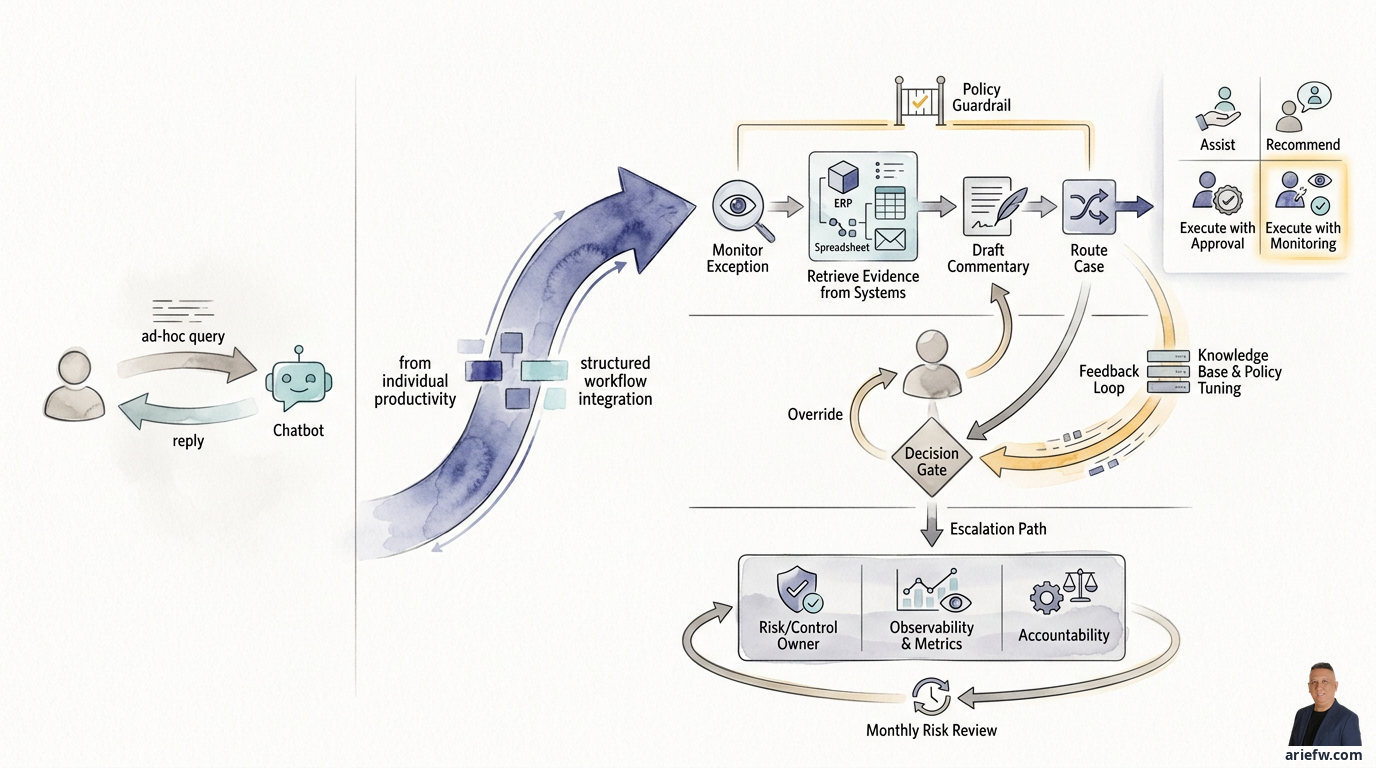
Many companies begin their AI journey in a similar way. A financial analyst asks a chatbot for a variance summary. A buyer requests a draft email to a vendor. A customer service agent asks for a response suggestion. All decisions and actions remain in human hands. AI is merely a tool that accelerates certain steps. The value is real, but its nature is still individual productivity.
This model has limitations. It boosts individual productivity without changing the underlying work architecture. However, when a company gets serious about AI, the situation shifts. The agent no longer just waits for ad hoc commands. It begins to participate in repetitive, structured workflows. The agent monitors exceptions, gathers evidence from multiple systems, prepares decision drafts, routes cases, calls tools, and even executes specific actions within established boundaries.
At this point, the human-AI relationship changes fundamentally. It is no longer a user employing a tool, but rather a human working alongside a digital teammate.
This change sounds simple, but its implications are vast. Once an agent becomes part of operations, the company must redesign the division of labor, decision points, accountability, operational rhythm, performance metrics, and the daily work experience. The question is no longer "how do I use AI," but "how do humans and agents work together as a single operating unit."
From User to Teammate
Imagine a controller on a finance team. Every month, they must review exceptions during the close process. Data is scattered across the ERP, spreadsheets, and email. They need to gather evidence, check policies, and prepare commentary. This work is repetitive, time-consuming, and full of handoffs.
In the old model, the controller could ask AI to summarize a document or find an answer. That helps, but it doesn't change the workflow. The controller still has to open all systems, check data one by one, and compile everything manually.
In the agentic enterprise, the pattern shifts. The agent doesn't just wait for commands; it participates in the workflow. In finance close, the agent monitors exceptions, gathers evidence from multiple systems, and then prepares a draft commentary for the controller. In procurement, the agent classifies intake requests, checks vendors and contracts, and routes cases to the correct path. In customer operations, the agent reads case history, checks entitlements, prepares responses, and for low-risk cases, can execute permitted actions. In IT operations, the agent enriches incidents, runs initial diagnostics, and escalates only the cases that truly require an engineer.
Here, the agent is no longer a "smart feature" on a screen. It becomes a member of the operational team with a defined scope of work.
Why this shift matters
Once an agent becomes a teammate, three things can no longer remain implicit.
First, interaction must be designed, not left to happen organically. If a human only occasionally asks AI a question, the interaction design can be loose. But if an agent is running a workflow, the company must determine when the agent works independently, when it asks for confirmation, when it hands off a case to a human, and how the human understands what the agent has already done. Without this design, handoffs will be chaotic. The human team won't know what to trust, what to double-check, and when to step in.
Second, trust must be built at the operational level, not through general perception. In the tool model, a user can try AI and decide for themselves if the result is useful. In the teammate model, trust must be more systematic. People need to know that the agent works within a clear scope, uses evidence that can be seen, adheres to policy, and can be stopped or overridden when necessary.
Third, accountability must remain human, even as execution becomes more digital. A company cannot say, "the agent decided." For decisions that impact customers, regulators, employees, or financial reports, external accountability still rests with humans and the institution. Therefore, the design of human-AI teaming must always answer: who is responsible for the final outcome?
When the teammate pattern isn't right
Not every use case needs to be forced into a human-agent team. If the work is still very sporadic, highly creative, or heavily dependent on negotiation and subtle social context, the standard assistant model is often more appropriate. Corporate strategy formulation, complex contract negotiation, handling emotionally sensitive customer escalations, or organizational decisions laden with political and cultural trade-offs are good examples. In these areas, AI remains useful, but it is safer positioned as an advisor rather than an operational teammate.
Division of Labor: What the Agent Does, What Remains Human
Healthy human-AI teaming is not born from the assumption that the agent will "take over everything that can be automated." Such an approach usually fails because it ignores the nature of enterprise work, which is full of exceptions, judgment, and accountability. What is needed is an explicit division of labor.
Work generally suited for agents
Practically speaking, agents are most powerful for work that requires speed, consistency, and persistence at high volume, especially if decisions can be supported by rules, evidence, or reasonably clear patterns.
Monitoring is one of the most suitable categories. Agents are highly effective for tracking continuously moving operational signals: invoice exceptions, shipment delays, untouched customer tickets, infrastructure alerts, or anomalies in the close process. Humans typically get tired monitoring large volumes continuously. Agents do not.
Retrieval and evidence assembly are also strong areas. Pulling data from multiple sources, consolidating policies, case histories, and supporting documents is often time-consuming work. An agent can significantly accelerate this phase. In finance, the agent gathers the trial balance, related journals, historical explanations, and relevant accounting policies before the controller reviews an exception.
Drafting is another category. For many processes, the greatest initial value comes from drafts: draft customer responses, draft close commentary, draft incident summaries, draft procurement request classifications. A good draft reduces the time to start from zero, but still gives the human room to assess.
Reconciliation, routing, and rule-based execution are also suitable for agents. An agent can match data across sources, find mismatches, and flag exceptions. It can determine which path a case should take, who the correct approver is, or when a case should be escalated. For certain use cases, an agent can execute low-risk actions already bounded by policy, such as opening a ticket, updating a status, sending a notification, creating a draft request, or processing low-value actions that meet the criteria.
Work that remains stronger in human hands
Conversely, there are areas where humans remain superior, not because the technology isn't advanced enough, but because the nature of the work demands human qualities and higher accountability.
Ambiguous judgment is one. When evidence is incomplete, rules conflict, or the business context changes rapidly, humans are better at weighing uncertainty. Empathy is also important. In customer operations, HR, or service recovery, the quality of human interaction remains critical. An angry customer or an employee facing a sensitive issue does not want to feel they are being "handled by a machine" at the wrong moment.
Negotiation, strategic trade-offs, and external accountability also remain with humans. Vendor negotiations, dispute resolution, or cross-functional compromises still require humans. Decisions involving business priorities, reputational risk, or resource allocation across units are not suitable for an agent. For decisions that must be accounted for to auditors, regulators, major customers, or the board of directors, humans remain the final authority.
Use the four-zone matrix
A practical way to design the division of labor is to use the following four zones. The Assist zone: the agent provides information, summaries, drafts; the human decides and executes. The Recommend zone: the agent gives evidence-based recommendations; the human approves or rejects. The Execute with Approval zone: the agent runs steps after approval; the human acts as a gate for specific actions. The Execute with Monitoring zone: the agent performs low-risk actions within policy boundaries; the human monitors exceptions and outcomes.
This matrix helps companies avoid two extremes: being too conservative, making the agent just an expensive chatbot, or being too aggressive, giving the agent autonomy before controls and trust are ready.
What should not be silently automated
One of the most dangerous mistakes is letting an agent drift into sensitive areas without an explicit design decision. Companies must consciously define which actions are prohibited, which decisions always require a human, and which conditions force an escalation. In finance, material accounting treatments must not be decided automatically. In HR, decisions affecting employment status or compensation must not be automated without strong governance. In customer operations, dispute cases, fraud suspicions, or high-priority customers are typically not suitable for full automation. In IT operations, high-risk production changes must not be executed by an agent without strict controls.
Trust and Adoption: It's Not About Accuracy Claims
Many AI programs fail at the adoption stage because they focus too much on selling "high accuracy" or "advanced reasoning capabilities." In real operations, trust is not built from such presentations. Trust is built when people feel they understand what the agent is doing, they can control the interaction, and the resulting work experience is consistently helpful, not burdensome.
The three most important foundations of trust
First, transparency. Users need to see the basis of the agent's work: what data was used, what policy was referenced, what tool was called, and why a particular recommendation appeared. This doesn't mean all internal reasoning must be exposed raw. What is needed is sufficient evidence to make a judgment. In customer operations, if an agent suggests a refund, the supervisor must be able to see the entitlement, case history, and policy underlying that suggestion.
Second, controllability. Users must be able to correct, give feedback, reject recommendations, or take over a case. If the agent feels like a black box forcing a workflow, trust will decline quickly.
Third, consistency. An agent that is sometimes very helpful but sometimes makes the workflow more complicated will be difficult to adopt. The experience must be stable enough that the team knows when the agent can be relied upon and when to be cautious.
Adoption increases if friction decreases
This is a principle often overlooked. People do not adopt an agent because the company says it's the future. They adopt it if the agent genuinely reduces real friction: less copy-pasting, less manual data searching, less switching between systems, less repetitive administrative work.
Conversely, adoption will decline if the agent adds unnecessary approvals, produces drafts that need to be completely rewritten, gives recommendations without evidence, or forces the user to re-check everything from scratch.
In finance close, if the agent only creates a draft commentary that still requires full verification from scratch, its value is small. But if the agent also gathers evidence, flags major variances, and shows the data source, the controller will feel their workload has genuinely decreased.
In customer operations, if the agent prepares a customer response but the supervisor still has to open five systems to check the basis of the decision, the agent hasn't solved the problem. What is needed is a more complete work package: recommendation plus evidence plus actions already prepared.
The feedback loop must be real, not symbolic
For trust to grow, human feedback must not stop at a thumbs-up or thumbs-down button. Feedback must flow back into the knowledge base, policy thresholds, golden scenarios for evaluation, and workflow tuning. If users feel their input never changes the agent's behavior, they will stop caring. In the end, the agent remains alive, but trust dies.
Operational Rhythm for Human-Agent Teams
Once humans and agents work as a single operational unit, the company needs a clear cadence. Without this rhythm, human-AI teaming will feel like a set of disconnected experiments.
Three rhythms typically needed
First, a daily exception review. The focus is on daily operations: cases the agent failed to handle, high override rates, recurring exceptions, pending actions, and approval bottlenecks. This rhythm is especially important during the early scale-up phase. The goal is not to audit every interaction, but to ensure the team quickly sees where the agent is helping and where it is creating new burdens.
Second, a weekly performance tuning session. At the weekly level, the team needs to review case volume, agent recommendation acceptance rate, escalation rate, correction rate, latency, and user feedback patterns. This is where tuning decisions are made: whether thresholds are too conservative, whether retrieval needs improvement, whether prompts or workflows need simplification, or whether certain case types should be removed from scope.
Third, a monthly risk and governance review. Monthly, the focus shifts to governance: whether there have been policy breaches, quality drift, regulatory or SOP changes, whether the level of autonomy is still appropriate, and whether the use case should be expanded or held back. This rhythm is important because a human-agent team is not just about productivity, but also about control.
Example operating cadence: finance close team
Here is a simple example for a finance team using an agent in the close process. Daily, the team reviews the list of exceptions not resolved automatically, checks the commentary most frequently overridden by the controller, and identifies entities or accounts that trigger the most escalations. Weekly, the team analyzes the draft commentary acceptance rate, reviews time saved on evidence gathering, evaluates whether the agent is too often pulling irrelevant documents, and updates evaluation scenarios based on real cases from the week. Monthly, the team holds a review with controllership, risk, and the platform team, checks if there are accounting policy changes that need to be added to the knowledge base, assesses whether the agent's scope can be expanded from draft to recommend in certain areas, or scaled back if quality is not yet stable.
Example operating cadence: customer operations
Daily, the team reviews cases that were reopened after being handled with agent assistance, checks refund recommendations rejected by supervisors, and identifies patterns of customers or products that frequently cause errors. Weekly, the team measures whether average handling time has truly decreased, sees if the agent is reducing or increasing handoffs, and improves knowledge articles that are most frequently used but often corrected. Monthly, the team reviews risks related to disputes, fairness, and policy compliance, evaluates whether there are customer segments unsuitable for further automation, and decides whether the agent can execute more low-risk actions.
Organizational implications: who leads the human-agent team?
Human-AI teaming cannot be managed by the technology team alone. It requires cross-functional ownership. The business owner is responsible for the process outcome. The team lead or operations manager is responsible for the daily working methods of the human and agent team. The platform or AI team maintains technical quality, observability, and evaluation. The risk, compliance, or control owner ensures the boundaries of autonomy remain healthy. The HR or talent leader helps redesign roles, capabilities, and performance expectations.
This also means the organizational structure needs to shift. A supervisor no longer just manages people, but manages a mixed workforce of humans and digital agents. They need to read new metrics, understand agent failure modes, and lead changes in team behavior.
Practical Checklist
Here are the decisions and checklist items to consider after understanding this topic.
Decisions to make now
Determine the teaming model for each use case. Is the agent to assist, recommend, execute with approval, or execute with monitoring? Explicitly define the division of labor. What work does the agent do, what does the human validate, and what must not be automated? Design the work experience to build trust. What evidence must be visible, when can the user override, and how does feedback lead to system improvement? Establish a formal operating cadence. Who leads the daily exception review, weekly tuning, and monthly risk review? Clarify organizational accountability. Who owns the outcome, who owns the agent, and who has the authority to increase or decrease the level of autonomy?
Quick readiness checklist
The use case is mapped to assist, recommend, approval, or execute mode. There is an explicit list of tasks suitable for the agent and tasks that remain with humans. Prohibited actions or those that always require escalation are defined. Users can see the key evidence used by the agent. There is an easy-to-use mechanism for override, feedback, and correction. Human feedback feeds into the knowledge base, policy, or agent evaluation. The operations team has a daily, weekly, and monthly review rhythm. Metrics measure not just productivity, but also override, escalation, correction, and risk signals. Supervisors or team leads understand how to manage a human-agent workflow, not just a human team. The business owner, technical owner, and control owner are clearly identified.
Danger signals
This topic is not ready for scaling or needs additional governance if the agent is positioned as a "people replacement" without a clear division of labor design, users cannot see the basis for the agent's recommendations, overrides are difficult or seen as user failure, feedback never leads to system improvements, approvals increase but work friction does not decrease, supervisors don't know how to read agent metrics, or accountability is unclear when errors occur.
Reflective questions for CIOs, COOs, CHROs, and transformation leaders
CIO: Is your architecture and observability sufficient to make agent work transparent and controllable by the operations team? COO: Are you truly redesigning workflows, or just layering AI onto old processes? CHRO: Are the roles of supervisor, analyst, and operator being redefined to lead digital teammates? Transformation leader: Is your company's agent reducing real friction, or is it adding new layers of work in the name of governance?
Ultimately, human-AI teaming is not about making humans "AI-assisted" a little faster. It is a redesign of the operating unit: who does what, who decides what, and how humans and agents together produce better outcomes. If this design is done with discipline, the company gains not only efficiency, but also a new work model that is more resilient, more measurable, and more ready to scale.