Business Case for Agentic AI: From Demo to Defensible Investment
A head of finance operations has just finished an agentic AI demo. On screen, the agent can find overdue invoices, match them against purchase orders, and prepare payment recommendations in seconds. The team is impressed. Business sponsors are already asking when it can go into production. But when the CFO, CIO, and risk management sit down together, the questions that emerge aren't about the demo. They're about the full cost, implementation risks, and proof that the promised value can actually be measured.
This scenario is familiar in many companies. Enthusiasm for agentic AI often hits a critical bottleneck: how to build a business case strong enough to secure investment, realistic enough to execute, and disciplined enough to be accountable for after production. The problem is that a business case for agentic AI cannot be structured like one for a chatbot or lightweight automation. Agentic AI touches workflows, decisions, integrations, controls, and the workforce in fundamentally different ways.
Why a Standard Business Case Isn't Enough
The most common mistake is treating agentic AI as a standard productivity tool, then calculating its benefits solely from hours saved. This approach is almost always misleading. For an individual copilot, personal time savings can be a valid starting point. But for agentic AI, value and costs emerge at a different level: the end-to-end value stream. An agent doesn't just help someone write faster. It can change how exceptions are handled, how decisions are routed, how backlogs are reduced, how SLAs are met, or how transactions are processed without human touch.
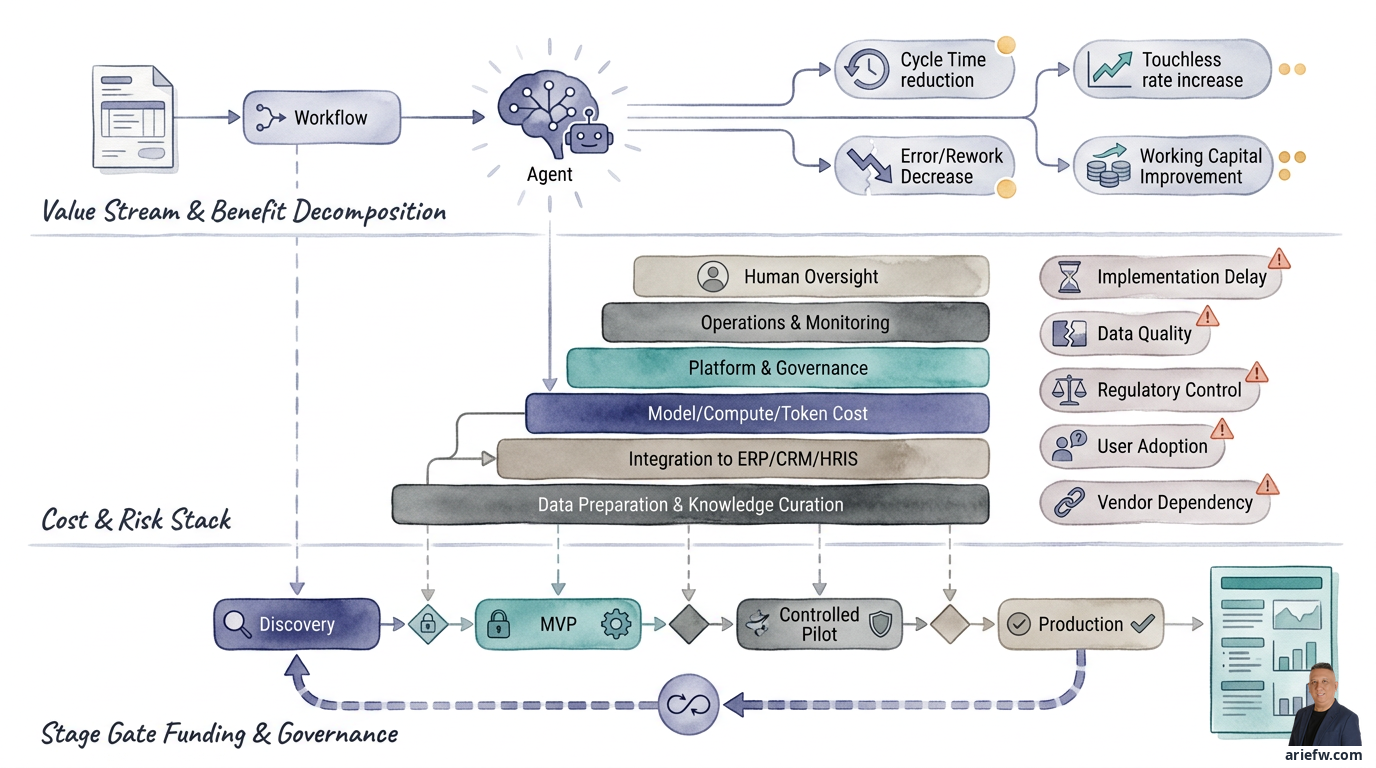
Consequently, an agentic AI business case must include components often overlooked during the demo phase: model, token, or compute costs; integration costs with ERP, CRM, HRIS, and other core systems; data preparation and knowledge curation; governance, security, and policy enforcement; monitoring, observability, and evaluation; change management and user training; and the human oversight that remains necessary, especially in regulated domains. If these aren't accounted for from the start, the business case will look compelling on a slide but collapse upon entering production.
A healthier way to think is to shift from the question "how many work hours can be saved?" to "how does the process economics change if an agent is placed at the right point?". In accounts payable, for instance, if the agent is positioned merely as a tool to summarize invoice mismatch cases, the benefit might only appear as time savings for analysts. But if the agent is used to triage exceptions, gather evidence, call PO and goods receipt data, open cases, and direct resolution, the impact can be seen on cycle time, backlog, touchless rate, error rate, and even payment discounts or vendor relationships. In customer operations, if the agent only helps write responses, its value is limited. But if the agent verifies customer context, checks entitlements, prepares actions, and resolves simple cases with bounded autonomy, then the business case must be viewed through first-contact resolution, resolution time, escalation volume, customer experience, and potential revenue retention. In other words, agentic AI must be evaluated as an operating model intervention, not just a work aid.
Value That Must Be Clearly Separated
A good business case doesn't lump all benefits into a single "efficiency" narrative. Benefits need to be separated by their value mechanism. Cycle time reduction is often the most tangible benefit in enterprise workflows. An agent can speed up context retrieval, triage, routing, and execution of standard steps. In finance close, exceptions are identified and routed faster. In procurement, intake requests are classified and directed more quickly. In IT operations, incidents are enriched and handled faster. In supply chain, shipping exceptions are responded to more rapidly. Cycle time reduction matters because it often drives derivative benefits: backlogs decrease, SLAs improve, and team capacity increases without immediately reducing headcount.
For high-volume processes, significant value often comes from increasing the proportion of transactions processed without full human intervention. Simple invoice exceptions can be handled automatically up to a point. Standard employee service requests can be resolved without escalation. Low-level IT tickets can be triaged and enriched automatically. Low-value refunds can be processed if they meet policy. Here, the relevant metrics aren't just time per case, but touchless percentage, cases per FTE, and throughput capacity during peak periods.
Many enterprise processes are costly not just due to volume, but due to errors, handoffs, and rework. An agent can reduce errors by checking document completeness, applying policies consistently, reducing manual copy-paste, and ensuring relevant context always accompanies handoffs. In vendor onboarding, an agent that checks document completeness and data consistency can reduce back-and-forth with the requester. In finance, an agent that prepares evidence packs with a consistent structure can reduce rework during reviews.
In some use cases, the greatest value isn't in transaction automation, but in accelerating decisions. Prioritizing exceptions during close, determining procurement paths, triaging IT incidents, or assessing mitigation options during supply chain disruptions are examples where faster decisions can reduce the cost of delays, improve stakeholder experience, and enhance operational resilience.
Customer or employee experience benefits are often considered "soft," yet in many functions they are highly material. Customers don't need to repeat case context. Employees get faster, more consistent HR answers. Vendors receive quicker responses on onboarding or disputes. Internal users get faster ticket resolution. However, experience benefits shouldn't be left abstract. They must be linked to operational metrics like SLAs, resolution time, escalation rate, or complaint recurrence.
For some use cases, the biggest benefit isn't labor savings. In collections, faster follow-up can improve cash flow. In order exception management, faster resolution can accelerate billing. In customer retention, better case resolution can reduce churn. In procurement, reducing intake delays can lower emergency purchases or maverick spend. This is important because many AI business cases too quickly fall into the logic of "how many FTEs can be saved," when larger economic value might come from cash, margin, or revenue protection.
Another discipline often missing is distinguishing between one-time gains—like clearing an initial backlog or accelerating catch-up—and recurring run-rate value, which is the benefit repeating every month or quarter. If the AP backlog drops dramatically in the first month due to an intensive pilot, that doesn't necessarily mean the run-rate value will be the same each period. The executive committee needs to see both separately to avoid misaligned expectations.
Where Business Cases Are Often Too Optimistic
If benefits are often exaggerated, costs are just as often underestimated. For agentic AI, this is dangerous because costs don't stop at the build phase. Build and implementation costs include use case design, agent development, tool and API integration, workflow configuration, testing, evaluation, and hardening for production. If the use case touches several core systems, integration costs can exceed the model costs themselves.
Model costs must be modeled based on transaction volume and complexity, not overly simplistic average assumptions. A single customer service agent might be cheap when tested on dozens of cases. But as volume increases, costs will be influenced by the number of interactions per case, context length, retrieval frequency, number of tool calls, the need for different models for different steps, and retries due to failures or ambiguity. The CFO and CIO need to see cost scenarios based on low volume, target volume, and peak volume.
Many organizations forget that for an agent to work well, they must pay for data cleaning, knowledge corpus curation, metadata addition, permission-aware retrieval construction, and keeping context quality up-to-date. This isn't a one-time cost. In many domains, knowledge and policies change continuously.
If a company is serious about building agentic capability, platform costs must be accounted for: identity and access control, policy engine, observability, audit logging, evaluation harness, secret management, and other security controls. These costs are sometimes invisible if the first use case "piggybacks" on an incomplete platform. But as scale increases, these costs become real.
An agent that is live still needs to be operated: quality monitoring, incident handling, prompt or workflow tuning, policy updates, retraining or reconfiguration, and support for business users. If there are no operating costs in the business case, the model is almost certainly not realistic.
Most importantly, in regulated or high-risk domains, an agent doesn't eliminate humans; it shifts human roles to approval, exception handling, quality review, and policy supervision. In finance, a controller may still need to review material exceptions. In procurement, a buyer must still approve certain categories. In HR, sensitive cases still need human review. In customer operations, refunds above a certain threshold still require a supervisor. If the business case assumes "full touchless" in a sensitive domain, the result will be overly optimistic.
Not All Use Cases Deserve to Be Evaluated the Same Way
Two use cases can both look attractive, but their risk profiles can be very different. The ROI of agentic AI should be adjusted according to confidence level and implementation risk. At least five risk groups need consideration. Implementation delays due to integration with core systems, security approvals, or data readiness can cause schedule slippage. Unstable data and context quality or an unprepared knowledge corpus will degrade agent performance. Regulatory or control reviews in certain domains require heavier legal, compliance, audit, or model risk scrutiny. Poor user adoption and operating model change—where supervisors, analysts, or frontline staff don't trust the agent—will prevent value realization. Vendor dependency on a specific model, platform, or partner can affect costs and flexibility.
A practical approach that often suffices is combining a simple financial value estimate—such as NPV or annualized benefit—with a confidence level for value realization. For example, an AP exception triage use case might have a high estimated annual value with high confidence, making it attractive. A finance close orchestration use case might have very high value but medium confidence, making it attractive but requiring stricter stage gates. A customer refund automation use case might have medium value with medium confidence, making it worthwhile if controls are strong. A vendor onboarding document check might have medium value with high confidence, making it a quick win candidate. The specific numbers will differ per company. What matters is the principle: high value with low confidence is not automatically better than medium value with high confidence.
Beyond financial value, the executive committee can use a simple scoring system for value potential, implementation complexity, control risk, reusability, and confidence level. This helps compare quick-win use cases that provide early evidence with more complex strategic bets that could transform the operating model.
Funding Should Be Phased, Not All at Once
Agentic AI should not be funded like a large project assumed to scale immediately. A healthier approach is stage-gate funding. In the discovery phase, the goal isn't to build a polished demo, but to validate the business pain, baseline, data and integration readiness, risk profile, and value hypothesis. The required outputs are a clear problem statement, an operational baseline, initial benefit and cost estimates, and a real business sponsor.
In the MVP phase, the company proves that the technical and operational pattern can work within a limited scope. The evidence sought includes output quality, basic integration, human oversight requirements, and early indications that process metrics can move.
The controlled pilot is the most critical phase for the business case. Here, the company tests the use case under more realistic operational conditions, with limited but representative volume, real business users, formal guardrails, and disciplined benefit measurement. At this stage, many business case assumptions will be corrected. That's healthy.
Production entry should only happen with evidence of value, risk and security sign-off, operating model support, observability, and a business owner ready to accept accountability. Scaling isn't just about increasing volume. It means expanding to other units, increasing autonomy levels where appropriate, leveraging reusable capabilities, and connecting use cases to a more standardized enterprise platform.
To ensure investment governance doesn't become a formality, each gate should require three types of evidence. First, evidence of value: are the process metrics actually moving? Second, risk sign-off: have security, compliance, legal, and control owners assessed the risks? Third, a readiness checklist: are data, integration, support model, and workforce readiness sufficient for the next stage? This approach helps avoid two extremes: scaling too fast without controls, or staying in pilot too long without a clear investment decision.
One Page for the Executive Committee
To keep discussions sharp, an agentic AI business case should be summarizable on a single executive page. Its minimum content should include the use case and value stream: what process is being touched, what bottleneck is being addressed, and why this matters to the business. The current baseline: volume, cycle time, error/rework, backlog, SLA, or other relevant metrics. The target outcome: which metrics are to be moved, over what time horizon, and whether the benefits are one-time or recurring. The proposed agentic solution: what the agent does, which systems it touches, its autonomy level (read/recommend/act), and where humans remain involved. The benefit case: labor/capacity, throughput, quality, working capital, revenue/CX, risk reduction. The cost case: build, license/model/compute, integration, platform, governance/security, operations, human oversight. The risk-adjusted view: key risks, confidence level, critical dependencies, and mitigations. The stage-gate ask: funding requested for the next phase, what evidence must be achieved, and what decision is requested from the committee.
This format forces the team to stop selling "interesting AI" and start proposing an operational investment that can be tested.
Ultimately, a good agentic AI business case isn't the most aggressive one. It's the one that is most honest about economics, disciplined about risk, and clear about the evidence that must be produced. That is the difference between organizations that merely collect demos and those that truly build an agentic enterprise.