Transforming Shared Services into Agentic Services
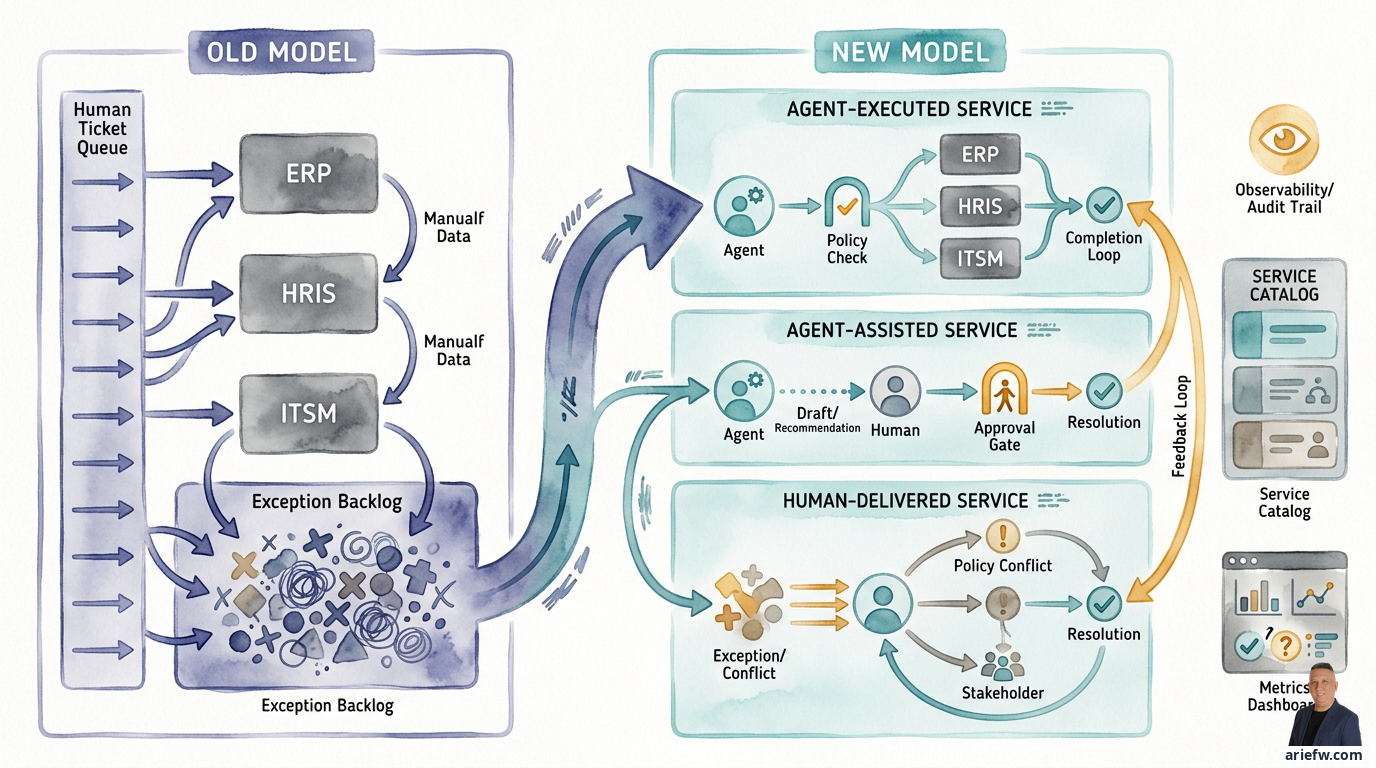
Imagine your finance operations team receiving dozens of invoice exceptions every day. Each case must be opened, read, matched against purchase orders and goods receipts, and then a decision made on whether it can be processed or needs to be rejected. Most of the time is spent searching for data across three different systems, not on making the decision itself. Or consider the HR services team repeatedly answering questions about leave and onboarding status, even though the answers already exist in the knowledge base. Or IT support busy resetting passwords while more complex incidents wait longer.
Shared services were born from a logical premise: standardize processes, consolidate volume, and achieve efficiency through scale. Finance, HR, procurement, IT, and customer operations were centralized so transactions could be processed more consistently. This model still works, but it is beginning to show its limits. Volume increases, the variety of exceptions grows, and business expectations shift from mere efficiency to speed and quality of outcomes. Tickets pile up. Handoffs increase. SLAs are met administratively, but the experience remains poor. Many teams end up busy moving work around, not completing it.
This is where agentic services emerge as a response—not as a chatbot layer on top of the service desk, but as a fundamental change in how services are delivered. It is no longer a delivery model primarily reliant on human labor, but a service based on teams composed of humans and agents. In this model, the agent reads the request, understands the context, calls systems, prepares actions, and directly resolves simple cases. Humans are not eliminated; their role shifts to handling exceptions, interpreting policy, managing stakeholders, and driving continuous improvement. The goal is not merely to reduce FTEs—because if that is the primary objective, companies typically build brittle automation and lose trust. A more appropriate goal is to transform the service model itself.
Why Shared Services Are the Right Place to Start
Not all functions are suitable starting points for an agentic transformation. Shared services, in fact, often make better candidates than highly strategic or highly unstructured functions. There are three main reasons.
First, high volume and repetitive work patterns. Shared services handle large quantities of work: invoice exceptions, employee inquiries, procurement intake, password resets, order status checks, disputes, onboarding tasks, and various similar case types. High volume offers two advantages simultaneously. There is enough historical data to understand case patterns, exceptions, and outcomes. And there is enough repetition to make the investment in agentic workflows economically viable.
Second, the processes are relatively standardized, even if not simple. Many shared services processes are not easy work, but they are structured enough to be broken down into orchestrated steps: read the request, classify the intent, retrieve data from systems, check policy, determine the path, prepare an action, and then resolve or escalate. This differs from highly strategic or highly negotiation-oriented work, where social context and human judgment are far more dominant.
Third, the operational data is extensive. Shared services typically already run on top of ERP, CRM, HRIS, ITSM, knowledge bases, SOPs, and workflow engines. The foundation for an agentic service already exists, even if it is often scattered and not yet ready for integrated use. Finance shared services have invoice data, POs, goods receipts, vendor master data, and payment policies. HR services have HRIS data, knowledge articles, case history, and benefit policies. Procurement operations have intake forms, contracts, vendor status, and approval matrices. IT support has ticketing, CMDB, runbooks, and telemetry. Customer operations have CRM data, order history, entitlement rules, and interaction transcripts.
However, it is important to understand: shared services are not an early candidate because they are easy to automate, but because they are rich enough to be redesigned. If a company is only chasing headcount reduction, it will tend to pick the narrowest, safest cases and stop at partial automation. That delivers local efficiency but does not transform the service model.
From Managing Tickets to Orchestrating Resolution
The most fundamental change in agentic shared services is the shift from managing a work queue to orchestrating resolution. In the old model, the service desk receives a ticket, reads the request content, searches for data across several systems, checks policies, and then decides whether the case can be resolved or must be forwarded. Much time is spent not on high-value decisions, but on administrative work and context searching.
In the agentic model, most of these initial steps can be handed over to the agent. For cases that are sufficiently clear and low-to-medium risk, the agent can read emails, forms, chats, or tickets; classify the type of request; retrieve context from the knowledge base and transaction systems; check status, entitlement, or policy; prepare actions such as draft responses or status updates; and, under certain conditions, execute the resolution.
Consider IT support. For requests like password resets, standard application access, or common incident status inquiries, the agent can read the request, verify identity and context, call the appropriate tool, and resolve the case without waiting for a human analyst. In HR services, for questions about leave, onboarding status, or policy documents, the agent can retrieve data from the HRIS and knowledge base and provide a personalized answer. If a simple administrative action is needed, the agent can prepare or execute it within defined authorization limits. In procurement operations, for standard purchase intake, the agent can classify the need, check if the item is available in the catalog, verify approved vendors, and then create a draft purchase request or direct the requester to the correct path. In finance operations, for simple invoice exceptions, the agent can match the invoice against POs and goods receipts, identify basic mismatches, and route to the correct path or prepare a resolution recommendation.
As the agent takes on more routine work, the areas where humans become even more important become clearer. Exceptions that don't fit the pattern, conflicts between policies, cases involving sensitive stakeholders, negotiations with vendors or customers, decisions with material impact, and continuous process improvement remain the domain of humans. The role of the shared services team changes. They are no longer primarily ticket processors, but become exception resolvers, policy interpreters, service quality managers, and trainers of the system through operational feedback.
In a mature design, the service desk is no longer synonymous with an inbox or a human queue. It becomes an orchestration layer that governs which requests can be resolved automatically, which need approval, which must go directly to a human, and how fallback occurs when the agent fails. If a company simply adds an agent in front of the old service desk without redesigning the workflow, the result is usually just a chatbot plus the old backlog. The value of the transformation is minimal. Autonomous resolution is suitable for cases with sufficiently stable patterns, available data, relatively clear policies, and limited impact. It is not suitable for cases that are highly ambiguous, highly emotional, or highly material without additional controls.
A New Service Catalog for Operational Control
Once shared services move to a human-agent team model, operational control can no longer rely on old service definitions. Companies need a new service catalog that distinguishes at least three types of services.
First, human-delivered service: services that remain primarily executed by humans due to high judgment, sensitivity, or risk. Examples include high-value customer disputes, HR decisions affecting employment status, material accounting treatments, or high-risk IT production changes.
Second, agent-assisted service: where the agent helps read context, prepare drafts, or provide recommendations, but the human remains the primary decision-maker. Examples include drafting finance close commentary, recommending sourcing paths, drafting customer complaint responses, or triaging incidents for engineers.
Third, agent-executed service: where the agent can complete the service directly within clear policy boundaries, with fallback to a human when necessary. Examples include password resets, order status inquiries, specific administrative data updates, routing standard purchase requests, or resolving unambiguous policy queries.
This distinction is important because each category requires different controls. Every agentic service needs relevant SLAs—not just response time but also resolution time. SLAs must reflect outcomes, not just acknowledgments. Escalation rules must be explicit: when should the agent stop, when should a case go to a supervisor, when is approval mandatory. An audit trail must allow the company to see where the request came from, what context was used, which tools were called, what actions were taken, and when a human took over. Without an audit trail, agentic shared services will be difficult to justify to internal audit, compliance, or process owners. Each service must also have metrics appropriate to its service mode. An agent-executed service cannot be measured the same way as a human-delivered service.
One of the most common design mistakes is treating fallback to a human as something to be avoided at all costs. In shared services, it is actually a critical control. Fallback is needed when data is insufficient, policies conflict, confidence is low, risk is too high, or the user rejects the agent's result. A healthy design is not one that forces the agent to resolve every case, but one that knows when to stop safely. If fallback is not well-designed, two things can happen: the agent becomes too aggressive and makes costly mistakes, or the agent becomes too conservative so that all cases still fall to humans and the business value is lost. Operating controls must govern not only what the agent is allowed to do, but also the level of confidence that is reasonably granted.
Measuring Value: From Efficiency to Quality of Outcomes
Agentic shared services are often sold with a productivity narrative. That is not wrong, but it is too narrow. The more important value is the change in service quality. Some of the most useful metrics are first-contact resolution—how many cases are completed on the first interaction; touchless processing rate—how many cases are completed without human touch; cycle time—how long from request intake to completion; exception backlog—whether difficult cases are piling up or decreasing; and cost per case—the actual cost to resolve one case. These metrics help determine whether the service model has truly changed, not just whether an agent is being used.
Efficiency without quality will erode trust. Therefore, agentic shared services must also be measured by error rate, compliance findings, user satisfaction, and a trust score or indicator of user confidence in the agent's results. A trust score does not have to be complicated. It can start with acceptance rate, override rate, or user feedback on the agent's recommendations. The important thing is that the company measures not only how much is automated, but also whether people trust it and whether the results are correct.
Example Blueprint: Agentic Finance Shared Service
Finance shared services are a good example because the processes are fairly structured, volume is high, but there are still clear areas requiring judgment. Imagine an organization starting with accounts payable and close support.
Services that could be agent-assisted include classifying invoice exceptions, gathering evidence from the ERP, drafting variance explanations, and summarizing aging issues for reviewers. Here, humans still make the final decision, but the time spent searching for data and preparing narratives drops significantly.
Services that could be agent-executed include answering invoice or payment status inquiries, routing vendor queries to the correct path, processing low-risk cases with very clear rules, and automatically opening or updating cases.
Services that remain human-delivered include decisions on material accounting treatments, exceptions involving fraud suspicion, vendor disputes requiring negotiation, and approval of high-value payments.
Required controls include a service catalog distinguishing the three service modes, SLAs per service type, value and risk tier thresholds, an audit trail for every tool call and recommendation, fallback to AP analysts or controllers, and weekly reviews of override and correction patterns.
Relevant metrics include touchless rate for vendor inquiries, cycle time for invoice exceptions, first-contact resolution for status queries, correction rate on draft commentary, backlog of exceptions waiting for humans, and compliance issues arising after implementation.
A blueprint like this shows that an agentic finance shared service does not mean finance without humans. What changes is who does what, when humans step in, and how the service is measured.
When Shared Services Are Not Ready for Transformation
Not all shared services are ready to be scaled immediately. Several warning signs need attention. The underlying processes themselves are not yet stable or documented. The knowledge base is full of outdated documents and conflicting policies. Integration with ERP, CRM, HRIS, or ITSM is still fragile. There is no clear service owner spanning operations, IT, and risk. Service metrics are still based only on ticket volume, not outcomes. The exception rate is very high and the causes are not understood. The organization still sees the agent merely as a labor-saving tool.
Under these conditions, an agentic transformation risks becoming a new layer on top of old chaos. The result is usually automation that looks sophisticated but is difficult to trust and hard to scale.
Decisions to Make Now
After understanding this topic, there are several decisions that should be made. First, choose the most viable initial shared services domain. Prioritize areas with high volume, fairly standard patterns, available operational data, and a clear process owner. Second, explicitly determine the service mode for each use case—which are human-delivered, agent-assisted, and agent-executed. Third, design fallback and escalation from the start; do not wait for the agent to fail in production before thinking about when a human should take over. Fourth, update the service catalog and service metrics, because agentic shared services cannot be managed with old service definitions focused only on tickets and headcount. Fifth, establish cross-functional governance, because the COO, CIO, process owners, risk, and HR need to agree that this is an operating model redesign, not just a tool project.
A reflective question for leaders is: are your company's shared services still designed as human-based ticket processing engines, or are they already being thought of as a portfolio of outcome-based services run by human-agent teams with new controls, metrics, and accountability? That is the question that will determine whether agentic AI becomes just an additional layer of efficiency, or truly transforms how the company delivers its internal and operational services.