Agentic AI Maturity Model for the Enterprise
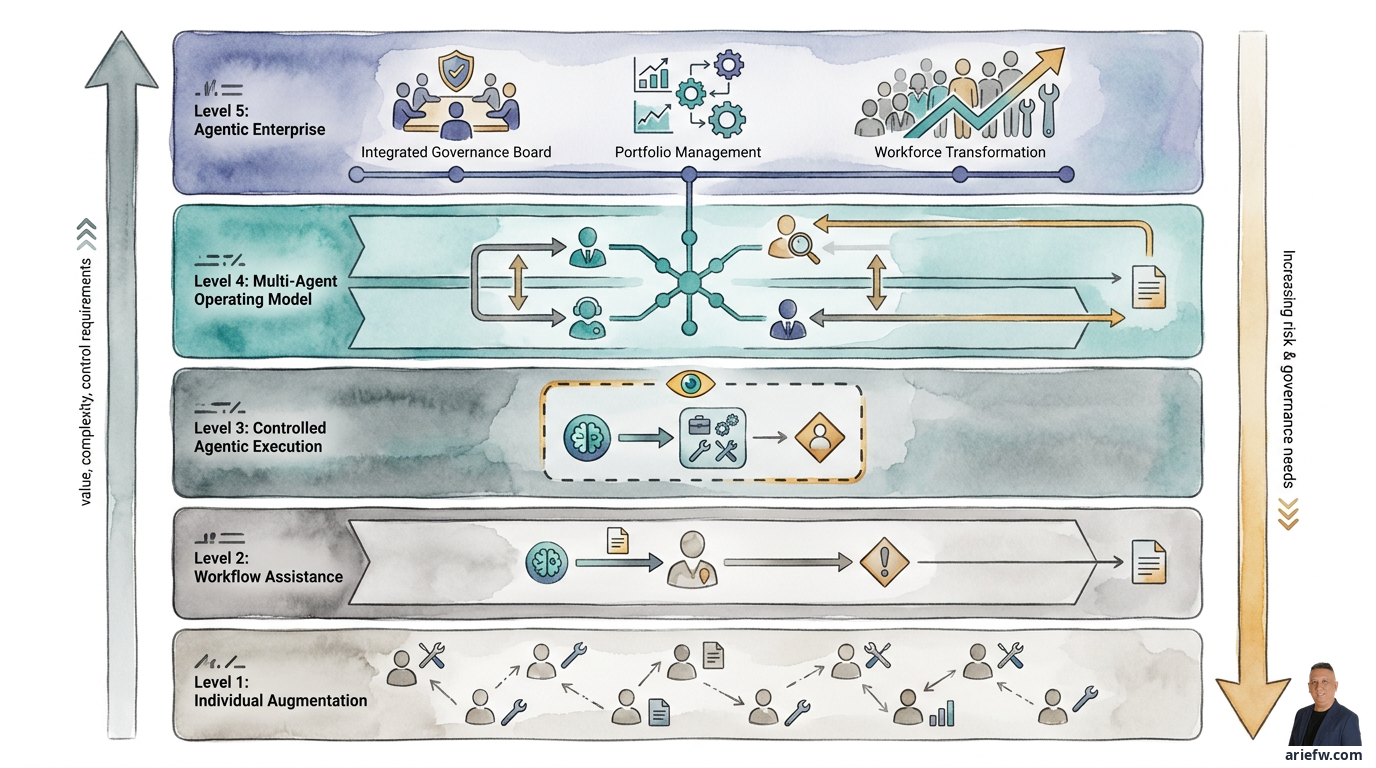
Imagine an executive meeting where one person says, "We're already using AI agents," while another envisions a knowledge base chatbot, another imagines a copilot that helps write emails, and yet another pictures a system that actually calls tools and executes actions within enterprise systems. Everyone uses the same term, but they are talking about vastly different things. If all of this is called "agentic AI," organizations will struggle to answer far more important questions: what level are we actually at, what foundations are in place and which are missing, what risks are emerging, and what does a realistic twelve-month target look like?
This is where a maturity model is needed. Not as a tool to appear advanced, but as a way to align language, set realistic targets, and avoid premature claims of transformation.
Why Companies Need a Maturity Model
Many organizations jump into pilots before understanding the level of capability they are building. The results are often familiar: business teams feel advanced because they have some AI use cases, technology teams feel the bottleneck is in data and integration, risk teams worry because controls are unclear, and executives struggle to distinguish between productivity experiments and truly scalable enterprise capabilities.
Without a maturity model, discussions become fuzzy. A knowledge base chatbot can be equated with a procurement agent. A copilot for finance analysts can be equated with a multi-agent system orchestrating close exceptions. Yet the foundational requirements, controls, and organizational impact are vastly different.
A maturity model serves at least four purposes. First, it aligns language across functions. COOs, CIOs, CFOs, CHROs, and risk leaders need a common language. If one party imagines an agent as a conversational assistant while another envisions a semi-autonomous executor, investment decisions will easily go astray.
Second, it sets realistic targets. Not every company needs to immediately pursue high autonomy. In many cases, the most sensible target for the next twelve months is not the autonomous enterprise, but moving from individual productivity to measurable workflow assistance, or from workflow assistance to controlled agentic execution in a specific domain.
Third, it connects value with foundations. The higher the maturity level, the greater the potential for end-to-end value. But the foundational requirements also increase: API maturity, data consistency, identity, policy engine, observability, and human-in-the-loop governance become increasingly critical.
Fourth, it helps avoid pseudo-transformation. Many organizations appear active because they have numerous demos. However, the main barriers are no longer purely technological, but organizational—ways of working and leadership. A maturity model helps distinguish AI activity from operational capabilities that are truly ready to scale.
How to Read This Maturity Model
This model consists of five levels: Individual Augmentation, Workflow Assistance, Controlled Agentic Execution, Multi-Agent Operating Model, and Agentic Enterprise. It is important to understand that this is not a ladder that must be uniformly climbed by the entire company. In practice, one organization could be at level 1 for HR, level 2 for finance, and level 3 for customer operations. Therefore, this maturity model is most useful when applied on two layers simultaneously: the company level in general, and the level per value stream or process domain. This way, companies can avoid two common mistakes: being overly optimistic at the enterprise level, or overly pessimistic because they see one lagging domain.
Level 1: Individual Augmentation
The first level is when AI is primarily used as an individual productivity tool. Examples are already very common: writing or polishing emails, summarizing documents, drafting presentations, assisting with initial analysis, searching knowledge bases for information, or helping with coding and documentation. At this level, value is usually felt quickly. Employees feel more productive, initial thinking time is reduced, and some administrative tasks become lighter. Because adoption is often bottom-up, this level typically grows the fastest.
However, from an enterprise perspective, there are clear limitations. The main problem with level 1 is that business value is difficult to measure formally. Productivity increases, but it is scattered across many individuals and not always connected to process metrics like cycle time, error rate, or cost per transaction. For example, in a finance team, an analyst might use AI to summarize variance commentary. In procurement, a buyer uses AI to draft vendor emails. In customer operations, a supervisor uses AI to polish escalation responses. All are useful, but they have not yet become reusable operational capabilities.
Because usage often occurs at the individual level, the most common risks are that sensitive data is entered into unapproved tools, there is no control over prompts and outputs, no reusable assets are built, and the organization does not systematically learn from this usage. At this level, companies often feel they are already using AI, when in reality they are only in the phase of personal adoption.
This level is appropriate for accelerating AI literacy, building usage habits, and identifying work areas that consume the most cognitive time. But level 1 is insufficient if the company's goal is to transform its operating model. If the organization stays here too long, AI will remain a personal tool, not an enterprise execution layer.
A sign that you are still predominantly at level 1 is high AI usage that is not connected to formal processes, no process owner responsible for AI outcomes, success metrics still being tool adoption or user satisfaction, and no meaningful integration into enterprise workflows.
Level 2: Workflow Assistance
At the second level, AI begins to be embedded within specific workflows, not just used freely by individuals. Humans remain the primary executors, but AI helps reduce time spent on searching, writing, analysis, and documentation in more defined processes. Examples include: drafting customer service responses based on case history, explaining variances in finance based on close data, summarizing incident tickets for the service desk, classifying procurement intake, or preparing employee onboarding documents. The key difference from level 1 is that AI is now situated within official work streams.
At this level, companies can begin to measure more concrete impacts, such as reduced cycle time, improved output quality, decreased rework, and adoption rates in specific processes. For example, in customer operations: AI helps service agents compose responses based on customer history and relevant policies. The human agent still reviews and sends it. The primary value is not that AI is used, but whether handling time decreases and response quality becomes more consistent. In finance: AI prepares a draft variance explanation for the controller. The human still validates it. Done well, commentary preparation time decreases and narrative quality becomes more uniform.
For many companies, level 2 is a very healthy target for the first wave. The reason is simple: business value starts to become visible, but risk remains relatively controlled because humans are still the primary executors.
However, this level also has its limits. If AI only helps prepare drafts, humans still must move decisions into systems, execute actions, follow up, and close process loops. This means level 2 improves efficiency, but has not yet fundamentally changed the economics of the process. For high-volume processes like AP exceptions, claims triage, or IT incident handling, the greatest value often only appears when AI can begin to act in a limited capacity.
A sign that you are at level 2 is AI is embedded in specific workflows, process metrics are starting to be used, humans still handle nearly all actions, integration with systems exists but is predominantly read-only or draft generation, and governance is emerging but not yet as strict as action-oriented systems.
Level 3: Controlled Agentic Execution
The third level is the most important inflection point. This is where AI no longer just helps with thinking, but begins to call tools and perform limited actions within clear boundaries. Examples include: an agent preparing and processing a refund for low-value cases that meet policy, an agent creating a remediation ticket in ITSM after specific validation, an agent sending a procurement request after checking completeness and policy, or a collections agent sending automated follow-ups based on approved rules. This is the level where the term "agentic" truly becomes operationally relevant.
Once an agent can act, foundations that previously felt optional become mandatory: identity and access control for the agent, a policy engine to limit actions, observability to track decisions and tool calls, an audit trail to explain what the agent did, and human approval workflows for specific cases. Without these, a company is not truly ready for level 3, no matter how impressive the agent demo looks.
In procurement, an agent receives an intake request, checks the spending category, approved vendors, and approval thresholds. If all conditions are met, the agent creates a formal request in the system. If there is a policy conflict, the agent stops and escalates. In IT operations, an agent receives an incident event, pulls logs, runs a diagnostic runbook, and then opens a remediation ticket with full enrichment. For low-risk remediation, the agent can execute specific steps. For sensitive production changes, the agent must request approval. In customer operations, an agent verifies refund eligibility, checks customer history, and then automatically processes small refunds. Large refunds or VIP customers are still routed to a supervisor.
This level delivers significantly more value than level 2, but it also changes the risk profile substantially. The main trade-off: value increases because actions become automated, but the need for controls, integration, and ownership also rises sharply. This is not a suitable level for organizations that are still weak in API maturity, data consistency, or runtime governance. If the foundations are not ready, forcing level 3 will only lead to incidents and a loss of business trust.
A sign that you are truly at level 3 is the agent has a formal identity and limited access rights, there is a clear separation between read-only and action tools, a runtime policy determines when the agent can act, observability and logging are available, and humans are involved through approval or exception handling, not as the default executor for every step.
Level 4: Multi-Agent Operating Model
At the fourth level, the company no longer manages agents as separate units per task. Multiple agents begin to work together under an orchestrator to complete value streams that span functions. This can occur in processes like lead-to-cash, issue-to-resolution in customer operations, source-to-pay exception handling, finance close orchestration, or supply chain exception management. Here, one agent is not enough. A combination of orchestrators, specialist agents, task agents, and humans as supervisors and exception handlers is required.
The most important change at level 4 is the shift from optimizing individual tasks to orchestrating end-to-end outcomes. In finance close, one agent monitors the close calendar, another analyzes journal anomalies, another prepares commentary, the orchestrator prioritizes exceptions, and humans step in for material approvals and complex case resolution. In supply chain, an agent monitors shipment events, another checks inventory and customer priority, a policy agent assesses mitigation options, and the orchestrator compiles cross-functional action recommendations.
At level 4, companies begin to see greater value because handoff bottlenecks between teams are reduced. AI no longer just accelerates a single step, but helps orchestrate the entire workflow. However, this is precisely where new risks emerge. The more agents work together, the greater the risk of too many agents being built without a clear catalog and ownership, two agents giving conflicting decisions, the orchestrator taking a path that violates policy, and accountability becoming blurred when the final outcome is wrong.
Therefore, level 4 requires a much stronger operating model discipline: ownership per agent and per value stream, a catalog of tools and agents, evaluation standards, cross-functional governance, and explicit design of human oversight. If basic processes are still chaotic, data across functions is not synchronized, and end-to-end ownership does not exist, forcing a multi-agent operating model is actually dangerous. In such conditions, it is better to strengthen level 2 or 3 in a narrower domain first.
Level 5: Agentic Enterprise
The fifth level is not just about having many agents. An agentic enterprise means the company already has an integrated platform, governance, operating model, workforce model, and portfolio management. At this level, agents are no longer innovation lab experiments. They become an official part of the company's execution layer.
Companies at this level typically have an enterprise agent platform that serves as a shared foundation, a governance board spanning business, technology, risk, legal, and HR, portfolio management for selecting, stopping, and scaling use cases, standardized identity, policy, observability, and auditability, a clear operating model for human-agent teaming, and a workforce strategy that shifts humans from routine transactions to oversight, exception handling, and continuous improvement.
A common mistake is to think level 5 means all processes run without humans. That is incorrect. An agentic enterprise is not about removing humans from all decisions. It is about making agents an official part of the company's work system, with clear authority boundaries and a mature accountability model. In some domains, bounded autonomy can be high. In other domains, human-in-the-loop remains dominant. What distinguishes level 5 is platform consistency and operating discipline, not just the degree of autonomy.
At this level, workforce changes are no longer local. The company needs to redesign frontline roles, supervisor roles, skills for exception management, new roles like agent owner, policy designer, and agent operations lead, as well as performance metrics for human-agent teams. Without this, a company could have a sophisticated agent platform but an unprepared human organization.
Self-Assessment Matrix: Where Does Your Company Stand?
Use the following five dimensions to assess your current position and your target for the next twelve months.
On the business value dimension, level 1 means value is scattered across individual productivity, level 2 means value is measurable in specific processes, level 3 means value comes from limited actions and reduced handoffs, level 4 means value emerges in cross-functional value streams, and level 5 means value is managed as an enterprise portfolio.
On the architecture and integration dimension, level 1 means separate tools with minimal integration, level 2 means read-only integration or drafting within workflows, level 3 means tool calling and limited actions with controls, level 4 means multi-agent orchestration across systems, and level 5 means an enterprise agent platform with shared standards.
On the governance and risk dimension, level 1 means basic usage policies, level 2 means per-workflow guardrails are emerging, level 3 means identity, policy engine, approval, and observability are mandatory, level 4 means cross-agent and cross-functional governance, and level 5 means integrated enterprise governance with audit and portfolio control.
On the operating model dimension, level 1 means individual usage, level 2 means AI assists human executors, level 3 means humans oversee limited actions, level 4 means humans focus on oversight and exception handling across agents, and level 5 means human-agent teaming is an official part of the company's operating model.
On the workforce readiness dimension, level 1 means basic literacy, level 2 means adoption per role, level 3 means training for approval, exception handling, and trust in automation, level 4 means role redesign and team capacity, and level 5 means workforce transformation connected to enterprise strategy.
If your company assesses itself at level 3 or higher, but does not yet have formal identity for agents, a runtime policy engine, observability, and cross-functional ownership, you are most likely still at level 2 with some level 3 experiments.
Setting a Realistic 12-Month Target
For most companies, a healthy twelve-month target typically follows one of three patterns.
First, from level 1 to level 2. This is suitable for organizations where AI usage is still predominantly individual. The focus is to select two to three priority workflows, embed AI into official processes, measure cycle time, quality, and adoption, and build basic guardrails.
Second, from level 2 to level 3. This is suitable for organizations that already have workflow assistance and want to unlock greater value. The focus is to select bounded, low-risk actions, build identity, policy engine, approval workflows, and observability, and ensure APIs and data foundations are mature enough.
Third, from level 3 to level 4. This is suitable for organizations that already have several action-oriented agents. The focus is to avoid agent sprawl, build an orchestrator and agent/tool catalog, establish cross-functional ownership, and begin managing value streams, not just isolated use cases.
Very few organizations can realistically target a full leap to level 5 within twelve months, unless they already have a very mature digital core, governance, and operating discipline.
Moving Toward Trustworthy Operational Capability
After reading the description above, you may be starting to wonder where your company currently stands. That question itself is already an important first step. Before setting a target, it is a good idea to conduct a brief diagnosis of your current situation. Does the term "agent" in your company have a consistent definition? Can you clearly distinguish between a copilot, a workflow assistant, and an action agent? Is your AI value still predominantly in individual productivity, or is it already connected to process metrics? Are there priority workflows that already have a business owner, a technical owner, and a risk owner? Do agents acting in systems already have an identity, limited access rights, and an audit trail? Do you already have a runtime policy engine to determine when an agent can act, request approval, or stop? Is your agent observability sufficient to explain tool calls, decisions, and exceptions? Are you managing agents as an enterprise portfolio, or still as a collection of pilots? Has the impact on human roles and reskilling needs been formally discussed?
The answers to these questions will help you determine the next steps. There are several decisions that executives need to make. First, determine the target level per domain, not just as an enterprise slogan. Finance, procurement, customer operations, and IT operations can have different maturity targets. Second, choose one realistic maturity leap for the next twelve months. Do not try to jump two or three levels at once without the foundation. Third, connect the maturity target with foundation investments. If you want to enter level 3, prepare APIs, identity, policy engine, and observability. If you want to enter level 4, prepare a cross-functional operating model. Fourth, use the value stream as the unit of prioritization. Avoid too many pilots that are not connected to business outcomes. Fifth, involve the COO, CIO, CFO, CHRO, and risk leader from the start. Agentic AI maturity is an agenda for the company's operating model, not just a technology project.
There are also danger signals to watch for. Too many demos and too few production use cases. Claims of autonomy when humans are still performing nearly all actions. Agents given system access without a clear runtime policy. No official inventory of active agents. Success metrics only being user counts or prompt counts. Workforce impact only considered after implementation is underway. If these signals appear, your company is most likely not ready to jump to the next level.
A good maturity model is not a tool to appear advanced. It is a tool to be honest about your current position, disciplined about your next target, and clear about the foundations that must be built. In agentic AI, speed is indeed important. But what matters more is whether the company can turn experiments into trustworthy and scalable operational capabilities.