Agentic Enterprise: From Digital Transformation to Agentic Transformation
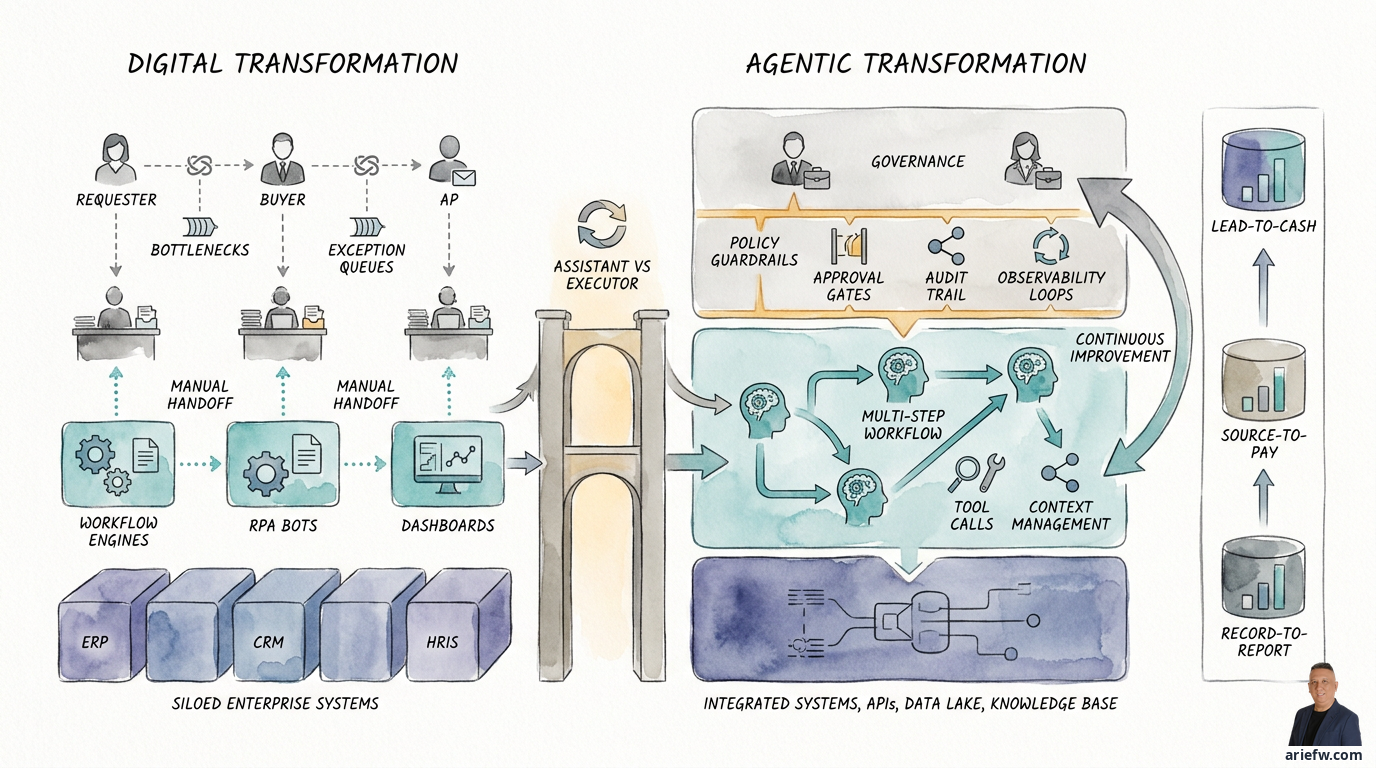
Many companies today feel they have made significant progress in digital transformation. Core processes run on ERP systems, approvals happen through digital workflows, dashboards display real-time data, and most employees already use copilots or chatbots to write, summarize, or find insights. But if we look deeper into large organizations, something hasn't truly changed. Work still moves from one inbox to another, from one team to the next, from one application to another. Bottlenecks remain; they just have a more modern appearance.
The question that arises is this: has the digital transformation already underway truly changed how companies work, or has it merely shifted manual work onto digital screens? And if the answer is the latter, what actually needs to change?
When digitization stops at the surface
Over the past two decades, large enterprises have invested heavily in digitization. They standardized processes in ERP, moved customer interactions to CRM, built shared services, adopted the cloud, and automated parts of the work with workflow engines and RPA. The results are tangible: visibility increased, compliance improved, and transaction costs dropped in many areas.
Yet, a clear limitation is emerging. Many transformation programs essentially just moved manual work onto digital screens. Paper forms became online forms. Physical approvals became electronic approvals. Reconciliations once done in spreadsheets are now handled through dashboards and exception queues. This is still progress, but it often fails to eliminate handoffs, simplify decision rights, or change who is responsible for what.
Take the source-to-pay process as an example. A company might already have e-procurement, a vendor portal, and automated three-way matching. But when an exception arises—a price mismatch, an incomplete PO, a problematic vendor master, or an ambiguous spend category—the work still bounces between the requester, buyer, AP, and vendor support. Digital systems help record and track, but they are not yet capable of intelligently orchestrating cross-functional resolution.
The same happens in the record-to-report process. Many organizations already have a global ERP and a disciplined close calendar. Yet when the close runs, finance teams still have to chase evidence, follow up on journal anomalies, request clarifications from business units, and consolidate explanations for auditors. The process is digital, but execution still heavily depends on human coordination.
The problem isn't the technology being used. ERP, CRM, HRIS, and other enterprise platforms are the backbone of modern operations. However, historically, these platforms were designed for standardization, control, and transaction efficiency. They are very powerful for stable processes with clear rules. They don't always excel when handling ambiguous context, dynamic exceptions, or multi-step coordination across systems and functions.
Because of these limitations, many companies add more layers: BPM, RPA, integration middleware, data lakes, workflow tools, knowledge bases, and more recently, GenAI assistants. The result is often an increasingly complex landscape. Each tool solves part of the problem, but the overall value stream remains fragmented.
Early GenAI: Helping individuals, not transforming the company
The emergence of generative AI provided a productivity leap at the individual level. Employees can write emails faster, summarize contracts, draft presentations, find answers in documents, or generate initial analyses. This is useful, especially for knowledge work.
However, in many companies, GenAI adoption stops at the level of personal assistance. AI helps someone work faster, but it doesn't automatically change end-to-end workflows. A procurement analyst might create vendor summaries faster. A customer service agent might compose responses quicker. A developer might write code more efficiently. But the overall business process still relies on humans to initiate, coordinate, decide, and close the loop.
In other words, old digital transformation and early GenAI often deliver an efficiency uplift, but not necessarily an operating model shift. Companies become more efficient on the surface, but the fundamental logic of work remains unchanged.
What actually changes with agentic AI
The major shift with agentic AI is not its ability to answer questions. The major shift lies in the system's ability to pursue goals, plan steps, use tools, manage context, and execute multi-step workflows with a degree of autonomy. This moves AI from being a tool to being an execution layer.
To understand the difference, consider the role of an assistant versus an executor. An assistant helps a human perform a task. An agent executes work towards an outcome. In the assistant model, the human remains the center of execution: the human breaks down tasks, chooses applications, moves context, and decides the next step. In the agentic model, part of that work shifts to a system that can understand objectives, formulate a plan, call tools or APIs, pull data from multiple systems, handle simple exceptions, request human approval when necessary, and continue the process until the outcome is achieved.
A simple example in customer operations: a traditional chatbot answers customer questions. An agentic system doesn't just answer; it can verify identity, check order status, initiate a refund according to policy, create a ticket if there's an exception, schedule a follow-up, and update the CRM—all within a single supervised flow.
An example in IT operations: a copilot helps an engineer read logs. An agentic system can detect an incident, gather relevant telemetry, run a diagnostic runbook, open an incident record, propose or execute low-risk remediation, and then escalate to an engineer if confidence is low or impact is high.
This is the most important change. Productivity is no longer measured per individual, but by the design of mixed teams of humans and agents. A portion of operational work will be executed by digital labor; humans shift to roles involving supervision, exception handling, policy design, and continuous improvement.
This doesn't mean all processes are suitable for high autonomy. Many domains still require strong human control—for example, credit decisions, sensitive master data changes, high-value payment approvals, or actions with legal implications. But even in these areas, agents can take over preparatory work, validation, orchestration, and documentation. Companies that understand this sooner will see agents not as an additional feature in an application, but as part of the workforce model.
Simultaneous redesign, not patches
A common mistake is to think agentic AI can simply be added on top of existing processes. In practice, the greatest value comes when a company is willing to redesign four things simultaneously.
First, processes. Not just automating old steps, but simplifying flows, reducing handoffs, and redefining exception paths. Second, systems and architecture. Agents need secure access to tools, APIs, data, events, and knowledge. Without a solid foundation of integration and context, an agent is just a more expensive chatbot. Third, governance and control. If agents can act, there must be clear boundaries of authority, approval thresholds, audit trails, observability, and accountability. Fourth, human roles. Supervisors, process owners, risk owners, and frontline managers need to know when an agent can act independently, when it must ask for approval, and who is responsible for the outcome.
Therefore, agentic transformation is not just an AI project. It is a cross-functional agenda involving business, technology, risk, and HR.
Why this becomes an enterprise agenda
Many organizations start AI with small use cases: internal chatbots, summarization, knowledge assistants, or single-task automation. That's natural. But agentic AI becomes an enterprise agenda when the focus shifts from task-level productivity to end-to-end value streams.
A company won't change its business economics just by making employees write emails faster. Strategic value emerges when agentic AI is applied to workflows that directly impact revenue, margins, cash flow, service levels, or risk posture. Relevant value streams include lead-to-cash, source-to-pay, record-to-report, customer operations, supply chain, and shared services.
In these areas, agents can reduce wait times, accelerate decisions, lower coordination burdens, and improve execution consistency. But only if the company sees it as a redesign of the operating model, not just an addition of AI features.
Once agents start executing actions, companies need to treat them like a digital workforce with defined work mandates, system access, authority limits, target outcomes, supervision, and audit trails. This brings real managerial implications. Who is the manager of the agent handling invoice exceptions? Who is the process owner setting the policy? Who is the risk owner approving the level of autonomy? How is agent performance measured—by speed, accuracy, recovery rate, or compliance? How is an agent stopped if its behavior deviates? Without answers to these questions, companies risk creating automation that is active but uncontrolled.
Avoid the trap of fragmented pilots
Many organizations will be tempted to run dozens of small pilots because the barrier to entry is low. The problem isn't the pilots themselves, but the fragmentation of ambition. If every function buys its own agentic tool, builds its own use case, and measures its own success, the result is agent sprawl: many demos, little enterprise impact.
Executives need to ask early: which value pool does this use case connect to? Does it solve a real bottleneck in a priority value stream? Can it be productionized with adequate controls? Is the data and integration foundation in place? If successful, can it be scaled across units? A good pilot isn't the most technically impressive one, but the one with the clearest path to a business outcome and a new operating model.
Starting the roadmap from business choices
If agentic transformation is a structural change, then its roadmap shouldn't start with a catalog of tools. It must start with business choices. The first question isn't which agent platform to buy, but in which value stream is the company most ready and most in need of shifting the locus of execution.
A CFO might choose record-to-report because the process is structured, the data is relatively clear, and the benefits directly impact close cycle time and control quality. A COO might choose customer operations because of high volume, many handoffs, and direct impact on service levels. A CPO might choose source-to-pay because exception management consumes significant effort and affects spend compliance. A CIO might choose IT operations because runbooks, observability, and incident workflows are mature enough for gradual autonomy. The choice of domain will determine the architecture, data, governance, and organizational change model.
A disciplined roadmap should connect at least five dimensions in every agentic initiative: business target, data and knowledge readiness, system integration, level of autonomy, and governance model. Without these five elements, companies tend to produce solutions that look sophisticated but are fragile when entering production.
Not all processes are suitable for agentic transformation first. Agentic AI is best suited for processes with sufficiently high volume, clear outcomes, many handoffs or exceptions, mappable rules, accessible data and systems, and risks that can be bounded with guardrails. Conversely, this approach is less suitable as a first wave for processes that are very rare, highly political, very ambiguous, or extremely sensitive from a regulatory standpoint without a mature control foundation. Examples include high-value strategic negotiations, complex legal decisions, or cross-jurisdictional corporate policy changes. In these areas, AI might still be useful as an advisor, but not yet ready to be the primary executor.
What needs to be decided now
After understanding the difference between digital transformation and agentic transformation, several initial decisions need to be made.
First, determine whether the company sees agentic AI as an individual productivity agenda or an operating model redesign. If it's still positioned as a personal tool, its impact will be limited. Second, select one to two priority value streams for the first wave. Avoid starting with too many small, disconnected use cases. Third, establish the permitted level of autonomy per domain. Differentiate between recommendation-only areas, human-in-the-loop, and bounded autonomy. Fourth, appoint cross-functional owners. At a minimum, there must be a clear business owner, technology owner, and risk/control owner. Fifth, decide if the digital core foundation is ready enough for production. If data, APIs, identity, and logging are not mature, the initial focus might need to be on readiness, not scale.
To assess readiness, several questions can serve as benchmarks. Has the company identified the most viable end-to-end value streams? Are the main bottlenecks, handoffs, and exception paths in that value stream understood? Are the required transaction data, documents, and knowledge relatively accessible and trustworthy? Do the core systems have realistic integration paths? Is there clarity on which actions an agent can execute and which require human approval? Have risk, security, legal, and audit functions been involved from the initial design? Is there a business sponsor pursuing operational outcomes, not just a technology demo?
There are also warning signs to watch for. If every function buys or builds its own agent without shared architecture and governance, that's a red flag. If use cases are chosen because they are easy to demo, not because they are important to a business value stream, that's a red flag. If there is no clarity on who is responsible when an agent makes a wrong decision or action, that's a red flag. If data and knowledge are scattered, uncurated, and lack an agreed-upon source of truth, that's a red flag. If core systems are difficult to integrate, limiting agents to chat and recommendations, that's a red flag. If the transformation team talks about models and tools but not about process redesign and workforce impact, that's a red flag. If success is measured by the number of pilots rather than genuinely changed business outcomes, that's a red flag.
Agentic transformation, ultimately, is not a story about replacing humans with smarter software. It is a story about redesigning the enterprise when digital labor begins to become a real part of daily work. The organizations that win are not the ones that build the fastest agent demo, but the ones that most diligently align business strategy, platform, governance, and workforce around this change.
In the next article, we will delve into a more technical yet highly critical question: what exactly is meant by agentic enterprise architecture, and how does it differ from traditional enterprise application architecture?