GCC 4.0: AI Agent-Powered Global Capability Center
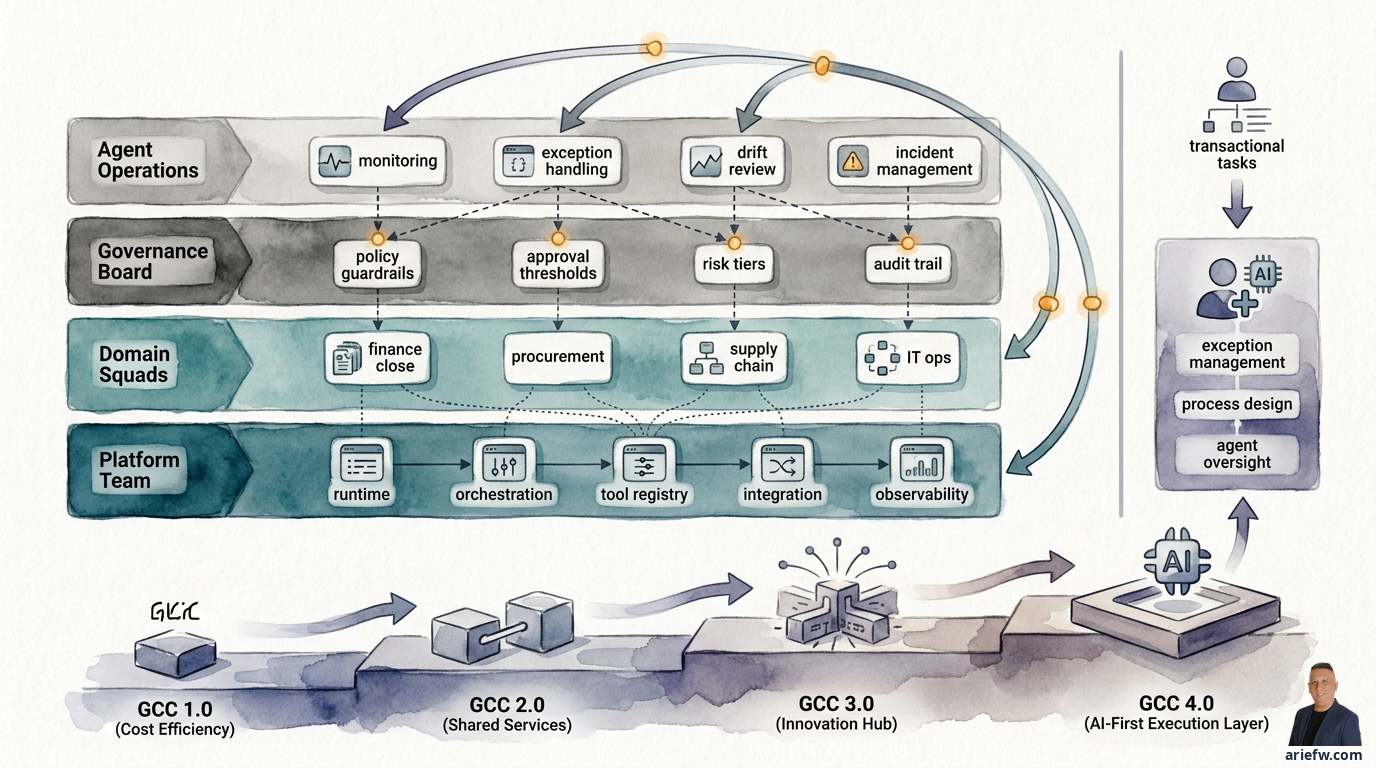
Imagine you are leading a Global Capability Center. For years, your team has been the backbone for centralizing work, reducing costs, and maintaining delivery standards. The mandate has gradually evolved: from a simple efficiency hub, to a more integrated shared services function, then a center of excellence, and finally an innovation hub driving digital transformation. Everything has been going well.
Now, your team is starting to experiment with AI. Perhaps there's a chatbot for common questions, or a copilot helping analysts draft reports. The results are promising, but you're beginning to see the limits. The chatbot can't access data from three systems simultaneously. The copilot only assists with one task, not the entire workflow. Business functions are starting to ask: can this AI do more? Can it make decisions on its own? But on the other hand, risk and IT teams are worried: what if it accesses the wrong data, or makes a commitment to a customer without authorization?
This is the point where the old question—what work can be moved to the GCC?—starts to feel outdated. The more pressing question now is: how can the GCC become an execution layer based on human-agent workflows for a global enterprise?
This isn't about adding AI to an existing GCC. It's about redesigning the GCC so that agents become part of the execution architecture, not just a productivity feature. This is where the concept of GCC 4.0 is born.
From Cost Efficiency to an Execution Layer
To understand why GCC 4.0 is different, we need to look at the evolution of GCCs.
In the first phase, GCC 1.0, the logic was simple: move work to locations with lower labor costs. The focus was on efficiency, standardization, and throughput. Value was measured by how much work could be done at a lower cost.
Then came GCC 2.0, or global business services. Here, the GCC began managing end-to-end processes across functions—finance, HR, procurement, customer support—under a single shared services model. Governance became stronger, and the GCC was no longer just a "cheap back office," but a more mature delivery engine.
Entering GCC 3.0, many GCCs evolved into innovation hubs. They became centers for analytics, automation, and digital engineering. They began influencing the enterprise roadmap, not just executing predefined tasks. However, this model still relied on traditional process logic: Lean, ERP consolidation, RPA, and automation of repetitive tasks. This approach was useful, but it started hitting limits when companies faced high volumes of exceptions, decisions involving unstructured data, cross-functional orchestration, and the need for more dynamic responses.
This is where agentic AI opens a new phase. GCC 4.0 is not just a GCC that adds a copilot to operations teams. It is a GCC that embeds agents into workflows from the initial design, combines human and digital labor in a delivery model, manages cross-system and cross-functional orchestration, and acts as the center for design, governance, and scaling of enterprise agents.
The difference is not cosmetic. In GCC 3.0, AI was used to speed up tasks. In GCC 4.0, AI becomes a structural execution layer. For example: in finance, the GCC doesn't just process close support; it operates agents for evidence gathering, exception triage, and drafting commentary across entities. In procurement, the GCC doesn't just handle intake and vendor support; it orchestrates agents for need classification, policy checks, and routing to the appropriate sourcing path. In supply chain, the GCC doesn't just monitor dashboards; it runs agents to detect exceptions, gather context, and prepare mitigation actions. In IT operations, the GCC isn't just a support layer; it's an operations center for agent-based triage, runbook orchestration, and escalation management.
Therefore, GCC 4.0 must be understood as a new operational capability center, not just a more efficient version of old shared services.
Why the GCC is the Right Place
Not every part of an organization is a suitable starting point for agentic transformation. The GCC, however, is often a very strong candidate, and this is no coincidence.
First, cross-functional processes are already in the GCC's DNA. GCCs are accustomed to working at the intersection of many domains: finance, procurement, HR, customer operations, supply chain, IT support, and sometimes analytics or engineering. Agentic AI is most valuable in workflows that cross functional boundaries, not in isolated, single tasks. The GCC already lives in that reality. They understand handoffs, exceptions, SLAs, and process dependencies. This makes the GCC more prepared than a unit that only sees one piece of a process.
Second, domain expertise and operational governance are already available. A mature GCC typically has process owners, SOPs, quality control, service management discipline, and experience running operations at high volume. This is important because agentic AI is not well-suited for environments where the underlying processes are still unclear. Agents need workflows that are reasonably defined, accessible data, accountable owners, and enforceable governance. GCCs often already have this foundation.
Third, the GCC is a controlled experimentation environment. One of the biggest challenges with agentic AI is how to experiment without creating enterprise-wide chaos. The GCC offers a relatively ideal environment: a large enough volume of work to prove value, processes standardized enough to test, yet centralized enough to control. This means a company can test human-agent workflows at a real operational scale without having to change the entire enterprise immediately. A reasonable example: piloting finance close support for a few entities, piloting procurement support for specific purchasing categories, or piloting supply chain exception handling for a particular region. If successful, the pattern can be replicated to other domains.
Fourth, the GCC can become an enterprise agent factory. Instead of each function building its own agents with different standards, the GCC can serve as the place to build reusable workflow patterns, the integration hub for ERP, CRM, HRIS, and core systems, the manager of governance templates, and the home for a capability academy for human-agent operations. With this position, the GCC is not just a user of agents, but a producer of agentic capabilities for the enterprise.
Fifth, the GCC can also be an exemplar of responsible AI. Once agents touch global processes, the risks increase: cross-border data access, differing policies across jurisdictions, delegated authority, auditability, and changes in workforce roles. A mature GCC is typically already accustomed to operational controls and compliance. If designed correctly, the GCC can be an example of how to run agentic AI responsibly: with risk tiers, approval thresholds, observability, audit trails, and a clear separation between recommend, draft, and execute. However, this is also a trade-off. If the GCC is too bureaucratic, innovation will be slow. If it's too loose for the sake of speed, risks will accumulate. GCC 4.0 must balance both.
The Changing Operating Model
For a GCC to truly become an AI-first execution layer, its organizational structure needs to change. Simply adding a few AI engineers to the old organization is not enough. Four organizational components are necessary.
First, the platform team. This team builds and operates the technical foundation: agent runtime, orchestration, tool registry, integration layer, identity and access control, observability, evaluation pipeline, and release management. Without a platform team, each domain squad will build its own path. The result quickly becomes expensive, difficult to audit, and hard to scale.
Second, domain squads. Each squad focuses on a specific business workflow, such as finance close, AP exception, procurement intake, customer case resolution, supply chain exception, or IT incident triage. This squad should ideally consist of a combination of process experts, product owners, operations leads, engineers, and risk/control representatives as needed. They are responsible for workflow design, tuning, and business outcomes, not just technical implementation.
Third, the governance board. GCC 4.0 needs a forum that decides which use cases are allowed into production, what level of autonomy is permitted, what minimum controls are mandatory, and when an agent's scope can be expanded. This board typically needs to involve a combination of the CIO, COO or operations leader, risk/compliance, security, HR, and domain owners. Without a governance board, critical decisions will be scattered at the project level.
Fourth, the agent operations team. This is a frequently overlooked component. Once an agent is live, someone must manage its daily operations: monitoring exceptions, reviewing override patterns, checking for drift, managing incidents, and coordinating rollbacks or threshold changes. Agent operations is the counterpart of service operations for digital labor.
The most tangible change in GCC 4.0 is not just in technology, but in the composition of work. Repetitive transactional work will increasingly be taken over by a combination of workflow engines, tool automation, and agents. Meanwhile, humans will shift to areas like exception management, process design, analytics, policy interpretation, stakeholder handling, quality supervision, and agent oversight.
Examples of role shifts: An AP analyst will no longer spend most of their time finding basic mismatches, but will focus more on exceptions that don't fit patterns and on root cause fixes. A procurement support specialist will no longer just route requests, but will design intake rules, oversee the quality of agent classification, and handle non-standard cases. A supply chain coordinator will work more on exception mitigation and cross-functional decisions, rather than just gathering status data. An IT support lead will focus more on incident patterns, runbook quality, and escalation design rather than high-volume manual triage.
This means the GCC's mandate must be elevated. If the GCC continues to be measured only by delivery efficiency and headcount leverage, the organization will tend to use agents only for short-term cost reduction. Yet the greater value comes when the GCC becomes an engine for building enterprise capabilities. GCC 4.0 should no longer be judged solely on cost takeout, throughput, or the number of transactions processed. Its mandate needs to include the reusable agent patterns built, the speed of scaling use cases across domains, the quality of governance and auditability, improvements in cycle time and resolution quality, and workforce readiness for the human-agent model. If this mandate is not elevated, the GCC will remain "shared services with AI," not a new execution layer.
Starting Small, Designing for Scale
Transforming a GCC to an AI-first model should not start with the ambition to "automate all processes." A healthier approach is to select the right workflows, prove the operating model, and then build reusable patterns.
The first step is to score processes with discipline. Start by assessing candidate processes based on four main dimensions. Automation potential: are there parts of the workflow that are sufficiently repetitive, rule-based, or can be supported by clear evidence? Complexity: how many systems, exceptions, and judgments are involved? High complexity is not always bad, but it's less suitable for a first pilot. Risk: what is the impact if the agent makes a mistake? Does it touch material transactions, sensitive data, or decisions requiring high accountability? Data readiness: is the required data and knowledge available, clean enough, and accessible with proper governance? Scoring like this helps avoid two traps: choosing a use case that is too easy and lacks value, or choosing one that is too ambitious and fails in the early stages.
For many companies, reasonable initial candidates in a GCC are finance close support, procurement support, and supply chain exception management. Finance close support: agents help with evidence gathering, variance triage, drafting commentary, and routing exceptions. The value is high because the close is repetitive, cross-entity, and often consumes a lot of administrative time. But clear boundaries are still needed: material accounting treatments remain with humans. Procurement support: agents help with intake classification, policy checks, vendor status lookups, contract references, and routing to sourcing or catalog paths. This is suitable because of the high volume, many repetitive questions, and significant opportunity to reduce rework. Supply chain exception management: agents help detect exceptions, gather context on orders, inventory, shipments, and suppliers, and then prepare mitigation recommendations. However, this is more suitable if operational data and integrations are already mature enough.
Once the pilot is running, the next focus is not just adding new use cases. The focus should be on building reusable assets: templates for agent-assisted and agent-executed workflows, policy and approval templates, integration connectors, evaluation harnesses, observability dashboards, and operating playbooks for supervisors. This is what differentiates healthy scaling from just having many pilots.
GCC 4.0 will not succeed if the workforce is only "trained to use AI tools." What is needed is a capability academy that teaches how to work with agents, how to assess evidence and overrides, how to manage exceptions, how to provide useful feedback, and how to lead human-agent teams. A capability academy is also important for supervisors and managers. They need to learn how to manage a mix of human and digital labor, read new metrics, and make decisions about levels of autonomy.
There are several warning signs that indicate a GCC is not yet ready to scale an agentic model: basic processes are still unstable, cross-system data is not yet trustworthy enough, ownership between the GCC, global functions, and IT is unclear, a governance board does not exist, the workforce sees agents only as a threat to headcount, or pilots succeed in demos but haven't shown operational fit at real volume. In such conditions, scaling will only amplify the problems.
Practical Implications
If you lead a GCC or are involved in transforming a global operating model, there are several decisions to make now. First, define the GCC's future mandate. Will the GCC remain positioned as a delivery engine, or will it be elevated to an enterprise agentic capability center? Second, choose the GCC 4.0 organizational model. Decide if you are ready to form a platform team, domain squads, a governance board, and an agent operations team as formal structures. Third, select 2–3 initial workflows for piloting. Prioritize use cases with a combination of business value, data readiness, and manageable risk. Fourth, establish autonomy boundaries from the start. Clearly differentiate between what is only assist, recommend, execute with approval, and execute with monitoring. Fifth, elevate the workforce agenda from efficiency to capability building. Decide how the GCC will retrain its workforce for exception management, supervision, analytics, and process redesign.
Before moving further, it's wise to check your GCC's readiness. Does the GCC already have sufficiently mature process owners and operational governance? Is there realistic access to the data, knowledge, and core systems required by the workflows? Do the global functions and the GCC agree that this is an operating model redesign, not a local tool project? Is there a platform team or technical foundation that can be used across use cases? Are risk, security, and compliance involved before production, not just after an incident? Are there candidate workflows with sufficiently high volume and sufficiently repetitive work patterns? Is the workforce plan starting to map role shifts, not just efficiency targets? Do the success metrics include outcome, quality, and governance, not just cost and headcount?
Be wary of warning signs before scaling. If the GCC is still measured almost entirely by cost arbitrage and throughput, if every domain wants to build its own agent without a shared platform and governance, if pilots are chosen because they are easy to demo rather than operationally important, if there is no clarity on who is responsible for agent exceptions, drift, and incidents, if cross-border or cross-functional data access lacks adequate controls, or if the AI program is perceived primarily as a headcount reduction agenda leading to low internal trust—then scaling is not yet appropriate.
A reflective question for CIOs, COOs, CHROs, and transformation leaders: if your company is building a new GCC or redesigning an existing one, are you creating a cheaper service center—or are you building a global execution layer where humans and AI agents jointly run enterprise operations? The answer to that question will determine whether your GCC is just following the AI trend, or truly becoming the foundation of an Agentic Enterprise.