Outcome-Based Operating Model
Imagine you lead a shared services finance team. For years, your team has been measured by the number of invoices processed per analyst, the average time to handle a ticket, and how full team members' schedules are. All these metrics made sense when nearly all the work was done by humans.
Now, your team is starting to use agents to help with close orchestration, prepare reconciliations, and handle exception invoice triage. Suddenly, most of the administrative work disappears. If you still use the old metrics, all you'll see is a "decline in human activity." But does that mean the team's performance has worsened?
The more relevant questions are: Are invoices being processed more accurately? Are exceptions being resolved faster? Is the backlog decreasing? Is the first-pass resolution rate improving? Can the human team now focus on cases that truly require judgment?
This is the core challenge many companies face as agents begin to enter workflows. Metrics like hours worked, effort, or headcount per process become increasingly less representative. What matters more is no longer how many activities are performed, but what outcomes are actually achieved.
Why the Old Way is Starting to Falter
When agents begin taking over tasks like reading context, routing cases, preparing actions, calling tools, and even completing certain transactions, the structure of work changes fundamentally. In finance, agents can assist with close orchestration. In procurement, agents can classify intake requests and check policy compliance. In IT operations, agents can perform incident triage. In customer operations, agents can resolve simple cases without human touch.
If management remains focused on activity, the organization will misread the value. Activity becomes an intermediate variable, not the primary goal. What matters more is the outcome that truly impacts the business.
The outcome-based operating model was born from this need: managing a company based on service results and business impact, rather than primarily on activity and workforce capacity. This is not just a change in KPIs. It's a change in how services are designed, how accountability is allocated, how internal and external contracts are structured, and how decisions are made about which use cases are worth scaling.
Outcomes are Closer to Business Value
What does outcome-based mean in concrete terms? Every function needs to define the results that truly matter. In finance, outcomes could be a faster and more controlled close, accurately processed invoices, or a reduction in reconciliation exceptions. In procurement, outcomes are requests entering the correct path from the start, improved procurement cycle times, and increased policy compliance. In customer operations, cases resolved on first contact, reduced repeat contacts, and improved customer satisfaction. In IT operations, faster issue resolution, fewer false escalations, and changes that are more release-ready.
Outcomes like these are far more useful than simply counting how many tasks have been automated. More importantly, outcome-based thinking forces a company to ask: does this task actually need to exist?
Many enterprise processes are full of legacy activities. Redundant checks that could be eliminated if data were better. Handoffs that exist only because of an old organizational structure. Approvals that are no longer proportional to risk. Manual reports that aren't used for real decisions. If a company only pursues activity automation, they will simply accelerate waste. Agentic AI actually makes this risk greater, because the technology can now automate more things. Without the discipline of outcomes, an organization can become very efficient at running the wrong processes.
Therefore, before building an agent, the first question should not be "which tasks can be automated?" but rather "what outcome do we want to improve, and which activities truly contribute to that outcome?"
From FTE to Service Outcome
The next shift occurs in how companies view both internal and external services. Many shared services, GCCs, and tech services are still managed with an effort-based logic: how many people are allocated, how many hours are used, how many tickets are processed, or how much team capacity is needed.
This model won't disappear entirely, but it becomes increasingly inadequate when digital labor becomes part of delivery. In an agentic model, throughput can increase without a linear increase in headcount. The cost structure also changes: there are costs for the platform, model inference, integration, observability, and governance, but there is a decrease in manual effort for certain volumes.
Consequently, pricing based on FTE or hours worked starts to lose relevance. If a service is now completed by a combination of agents, workflow engines, and human supervisors, then charging for or allocating costs based solely on human effort becomes misleading.
Real examples exist. A shared services procurement team that once charged back based on the number of support staff per business unit now makes more sense measured by outcomes like requests resolved, cycle time, or compliance rate. IT services once calculated by the number of tickets handled at level 1 can shift to metrics like incidents resolved within target, service restoration time, or change success readiness. Finance operations once justified by the FTE-to-transaction volume ratio now need to look at cost per correctly processed invoice or cost per resolved exception.
This shift also touches vendor contracts. In agentic services, a company isn't really buying a "tool" or "extra labor," but is increasingly buying a service outcome. Managed services and outsourcing contracts need to move from input-based pricing, time and material, or simple headcount leverage, towards models closer to quality throughput, resolution outcomes, compliance outcomes, or specific business KPIs.
This isn't always easy. Not all services are suitable for purely outcome-based contracts. If the process is heavily influenced by external factors or the client's own data is poor, vendors will find it difficult to accept full risk. However, the direction of the shift is clear: as agentic delivery matures, the logic of effort-based pricing weakens. In situations where outcomes cannot be clearly defined, a quality baseline doesn't exist, external factors are too dominant, or control over data and processes is still fragmented, companies can start with a hybrid model: part fixed cost based on capacity, part based on agreed-upon outcomes.
Who Holds the Decision Rights and Responsibility
The outcome-based operating model sounds appealing, but it demands higher organizational discipline. Once the focus shifts to results, a company must be very clear about who has the authority to decide what, and who is responsible when outcomes are not achieved.
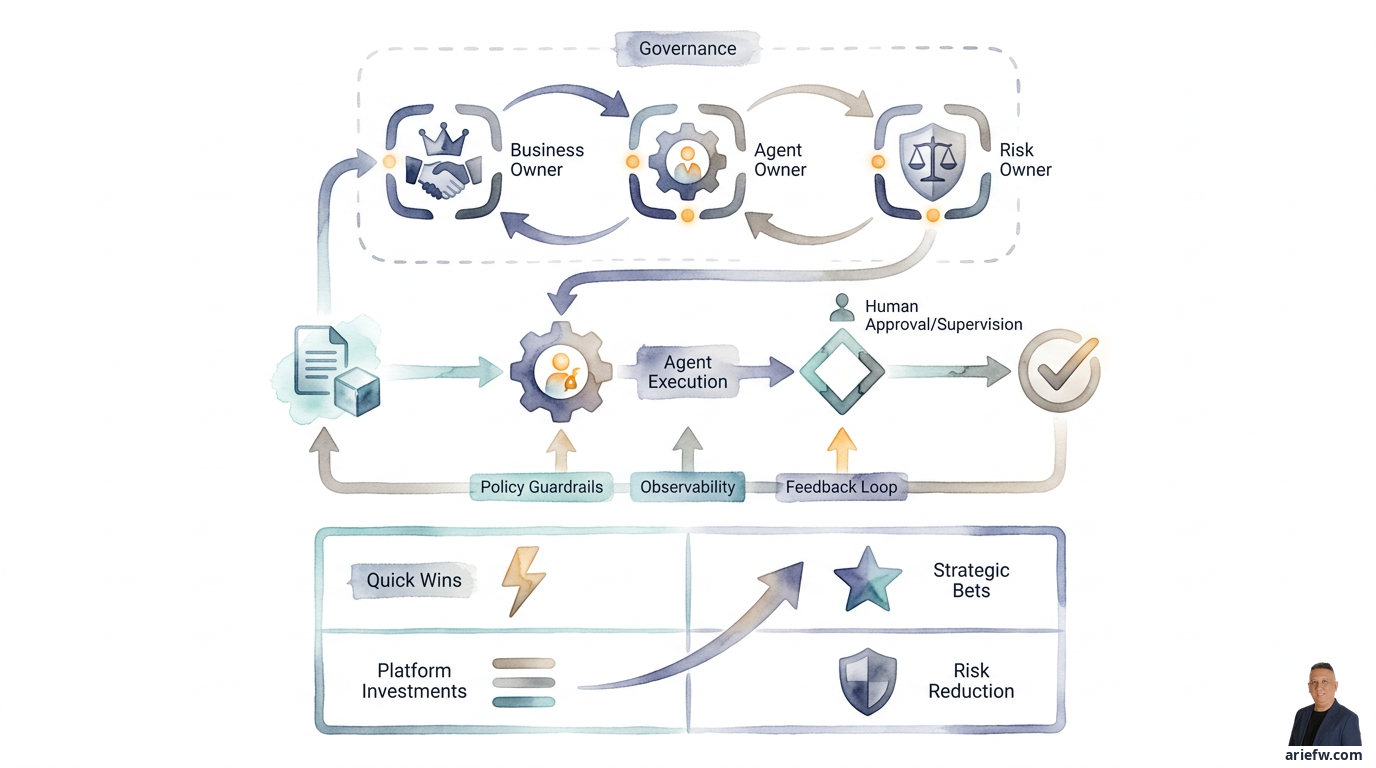
In an agentic enterprise, at least three distinct roles need to be defined.
First, the business owner. This person is responsible for the outcome of a service or process. They define the business targets, use case priorities, success criteria, and acceptable operational trade-offs. Examples include: the CFO or controllership lead for close outcomes, the CPO or procurement operations lead for intake-to-PO outcomes, the COO of customer operations for case resolution outcomes, and the CIO or head of operations for incident recovery outcomes.
Second, the agent owner. This person is responsible for the design and performance of the agent within the workflow: how the agent works, what tools it calls, what evaluations are used, what thresholds are applied, and how changes are released. This role often resides with a product owner, platform owner, or domain squad lead.
Third, the risk owner. This person ensures that bounded autonomy stays within guardrails: what policies apply, what approvals are mandatory, what data can be accessed, and when a use case should be paused or limited. In specific domains, the risk owner might come from compliance, internal control, security, legal, or operational risk functions.
One real test of an outcome-based model is when results don't meet expectations. For example, an invoice is processed incorrectly, an incident is routed wrongly, a forecast exception is not handled, or a customer case is closed too quickly but the problem isn't solved. In such situations, the organization must be able to distinguish whether the root cause lies in incorrect or incomplete data, ambiguous or outdated policies, a failed tool or integration, poor model or agent behavior, or a fundamentally flawed process design. Without this separation, all failures will be lumped into a single basket called "AI error," even though the corrective actions are different.
One principle must remain clear: agents do not hold accountability. Agents can execute actions, provide recommendations, or orchestrate workflows, but responsibility remains with the humans and the organizational structure. From a governance perspective, a company cannot transfer responsibility to a system. If there is a material error in finance, a policy violation in procurement, or a security incident in IT, the process owner and the organization are still held accountable. Operationally, clarity of accountability prevents confusion. If everyone assumes "the agent was wrong," then no one will actually fix the data, policy, or process design.
Managing Initiatives as an Outcome Portfolio
Once a company has many agentic initiatives, the challenge is no longer just building use cases, but managing a portfolio of outcomes. Not every use case is worth continuing, and not every quick win is worth scaling.
Practically, an agentic portfolio usually needs to balance four categories. Quick wins: use cases with clear value, controlled risk, and sufficiently ready data. Examples include intake classification, invoice triage, or service desk resolution for standard cases. Strategic bets: use cases with the potential to more significantly change the operating model, but are more complex. Examples include cross-entity close orchestration, supply chain exception coordination, or multi-agent IT delivery workflows. Platform investments: initiatives that may not show immediate value in a single process but are critical for scale, such as identity, observability, policy engines, integration layers, and evaluation harnesses. Risk reduction initiatives: improvements to data, controls, auditability, and governance that allow other use cases to run safely.
If a company only pursues quick wins, they will have many pilots but little transformation. If they only pursue strategic bets, they risk being too slow and losing momentum. A healthy portfolio requires balance.
An outcome-based model also demands the discipline to stop initiatives that aren't viable. Every use case should have clear stage gates: Is the business problem real? Is a baseline available? Are the data and policies sufficiently ready? Does the pilot show improving outcomes? Are the correction rate and risk profile still acceptable? Are the economics sound? If the answer is no, the use case should be stopped, narrowed, or redesigned. This is important because agentic AI can easily create an optimism bias. A good demo often makes an organization reluctant to admit that a particular use case isn't valuable enough or is too risky for now.
Portfolio reviews should not be just a technology forum. They must involve the business owner, the CIO or CTO or platform leader, finance, risk or compliance or security, and, where relevant, the CHRO or transformation office. The decision to scale isn't just about whether the agent works, but whether the business outcome is real, the governance is adequate, and the organization is ready to absorb the change.
Practical Next Steps
After understanding why the outcome-based model is important, there are several decisions to make now. First, determine the primary outcome for each priority workflow. Don't start from a list of tasks that can be automated. Start from the results you want to improve: resolution time, accuracy, compliance, service level, or decision quality.
Second, review your chargeback models, pricing, or business cases. If services are still measured primarily by FTE and effort, decide which outcome metrics you will start using for shared services, GCCs, tech services, or vendor-managed services.
Third, explicitly define decision rights. Differentiate between the business owner, agent owner, and risk owner. Ensure it is clear who owns the outcome, who manages agent performance, and who sets the guardrails.
Fourth, build stage gates for your agentic portfolio. Every use case must have criteria for proceeding, redesigning, or stopping. Don't let all pilots run indefinitely without a decision.
Fifth, change the focus of review forums from activity to outcome. In steering committees or operating reviews, reduce the focus on the number of automations and hours saved. Increase the focus on quality, resolution, trust, risk, and economics per outcome.
Several warning signs need attention. The AI program is still justified primarily by headcount or hours reduction. Use cases are chosen because they are easy to demo, not because their business outcome is important. There is no clear owner for the outcome, agent performance, and risk. Agent failures are always discussed generically without root cause analysis. Vendors or internal teams are still measured almost entirely by effort, not service results. The portfolio is full of pilots, but there are few decisive actions to scale, redesign, or stop. The governance board only looks at technology adoption, not outcome quality and controls. The organization is not yet ready to accept that some activities should be eliminated, not automated.
If tomorrow most of the routine activities in your function were taken over by agents, would your management model still make sense? Or are you still managing the company based on headcount and hours worked, rather than on the service outcomes truly being created?
That is the core question of the outcome-based operating model. In the agentic enterprise, the winning company is not the one that automates activities the fastest, but the one that manages results with the most discipline.