What Is Agentic Enterprise Architecture
Imagine your finance team is going through the monthly close process. Data is scattered across the ERP, spreadsheets sent via email, and manual records from shared services. It takes days to reconcile, check for anomalies, and obtain approvals. Now imagine something that can monitor the close calendar, detect entities that haven't submitted reconciliations, analyze suspicious journal entries, gather evidence from various systems, and prepare recommendations for the controller—all in minutes, not days.
It sounds compelling. But the immediate question is: how? What needs to be in place for something like this to actually run in a company, not just be an impressive demo?
That question brings us to the concept of agentic enterprise architecture. The term may sound technical, but its essence is deeply operational. It is a blueprint for how a company places AI agents on top of existing systems, how agents understand business context, how they act through enterprise systems, and how all their actions are governed to be safe, auditable, and scalable.
Without a clear architecture, companies typically fall into one of two extremes. The first extreme: AI stops at being a chatbot that is good at answering questions but cannot get work done. The second extreme: agents are given overly broad access to systems and data without adequate controls. Both are equally problematic.
Why This Is Not Just a Smarter Chatbot
Many organizations still view agentic AI as a natural extension of generative AI: smarter models, better prompts, a more convenient interface. This perspective is too narrow.
The change underway is actually closer to the evolution of enterprise platforms. For years, ERP, CRM, HRIS, and workflow engines have been the backbone of transactions and controls. These platforms were built for process standardization. They are strong for stable rules but lack flexibility for cross-system orchestration, exception handling, and operational decisions that require dynamic context.
Agentic AI is emerging as a new orchestration layer on top of these platforms. It is not replacing ERP or CRM. It becomes an interface and executor that can understand goals, gather context from multiple sources, call tools or APIs, execute multi-step workflows, and pause to ask for human approval when needed.
Therefore, agentic enterprise architecture is not an AI feature topic. It is an enterprise architecture topic: where AI lives, how it connects to platforms, how it accesses data, and how its actions are governed.
Three Things That Distinguish an Agent from a Chatbot
Simply put, agentic enterprise architecture is a system design that enables AI agents to understand context, make bounded decisions, and act through enterprise tools to achieve specific business outcomes. There are three key words here.
First, understanding context. An agent that only receives a prompt without enterprise context will be useless for real operations. In a company, context means a combination of transaction data, documents and knowledge bases, process metadata, interaction history, policy rules, workflow status, and user or business unit access rights. For example, in a procurement process, it is not enough for an agent to know that an invoice is on hold. It also needs to know which vendor is involved, whether the PO is valid, whether there is a price mismatch, who the approver is for that category, the applicable tolerance policy, and whether a similar case has occurred before.
Second, making bounded decisions. The word bounded is critical. A healthy agentic architecture is not built on the assumption that the agent can decide anything. Instead, it is designed with a clear decision scope. An agent may classify IT tickets and run initial diagnostic runbooks. An agent may draft adjustment journal entries and prepare evidence. An agent may propose collection follow-up actions based on policy. But an agent should not automatically change vendor master data, approve large payments, or close critical incidents without additional controls.
Third, acting through enterprise tools. This is the main differentiator from a chatbot. Chatbots answer. Agents act. Acting means using tool calling, APIs, workflow engines, robotic actions, or application integrations to do something in a real system: create a ticket, update a CRM, trigger an approval, pull data from an ERP, run a query, or send instructions to another platform.
So, agentic enterprise architecture is not about building one super agent that knows everything. The goal is to build an ecosystem of agents that is controlled, modular, and scalable.
The Three Layers That Form the Architecture
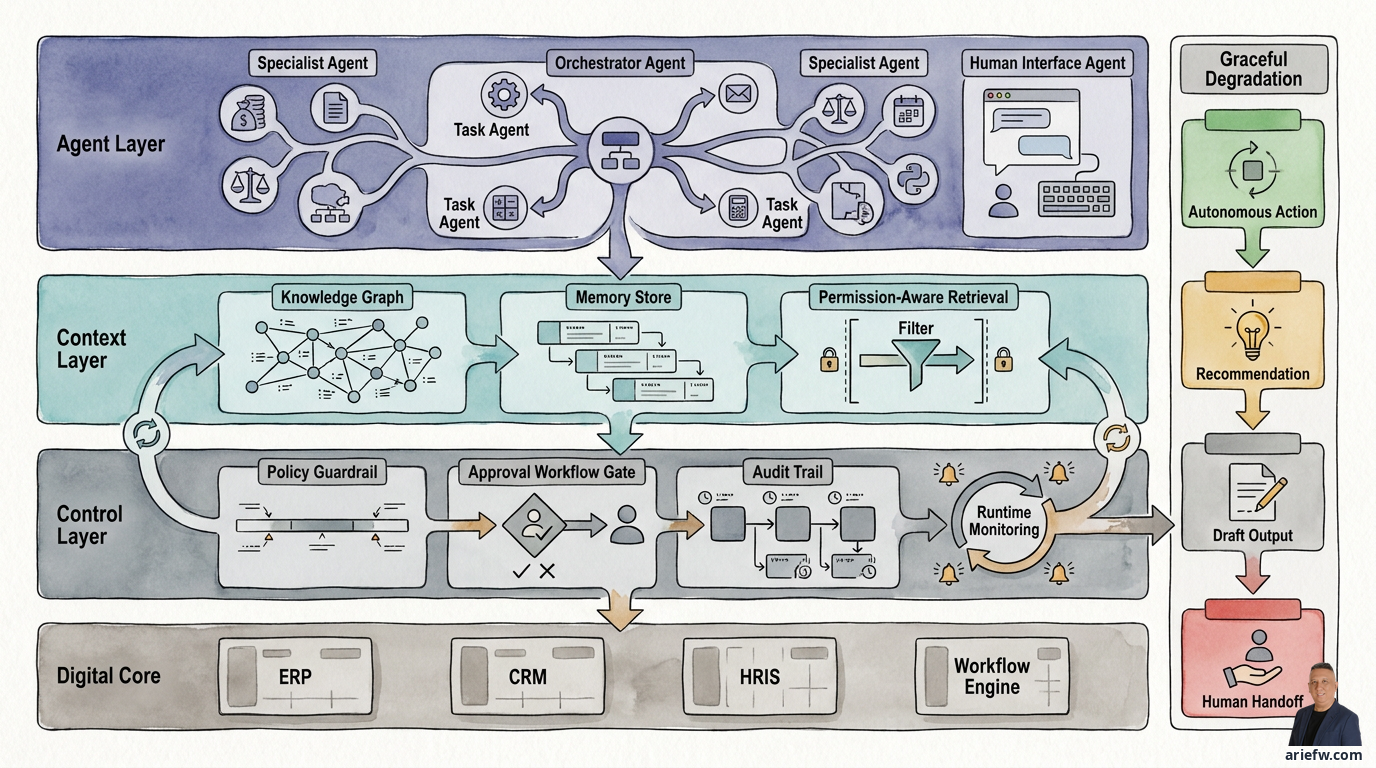
The most useful way to understand this architecture is to see it as three layers: the agent layer, the context layer, and the control layer. Beneath them remains the company's digital core: ERP, CRM, HRIS, data platforms, workflow engines, and other operational applications.
The Agent Layer: Who Does What
Not all agents should have the same role. One of the most common design mistakes is creating a single generic agent for all needs. The result is usually poor: hard to control, hard to test, and hard for the business to trust.
A healthier architecture distinguishes several types of agents. An orchestrator agent manages workflows across steps or across agents. It does not have to be the most expert in every domain, but it knows the sequence of work, when to call a specialist agent, when to call a tool, and when to escalate to a human. In a finance close, the orchestrator monitors the close calendar, detects entities that haven't submitted reconciliations, calls a specialist agent for journal anomaly analysis, requests evidence from shared services, and then sends material exceptions to the controller for approval.
A specialist agent focuses on a specific domain. For example, a procurement policy agent, a contract analysis agent, a customer complaint triage agent, a root-cause analysis agent for IT incidents, or a supply chain exception resolution agent. Its advantages are a narrower scope, more specific knowledge, and easier evaluation.
A task agent handles more atomic and repetitive tasks. For example, extracting data from an invoice, comparing documents against standards, creating a case summary, filling in specific fields in a system, or validating the completeness of onboarding data. Task agents are well-suited for high-volume work with relatively clear rules.
A human interface agent interacts directly with people, whether employees, managers, vendors, or customers. It can exist in chat, portals, email, voice, or internal workspaces. However, its role is not just conversation. It serves as the entry point to the broader agentic system. In HR operations, an employee asks about the status of a reimbursement. The human interface agent understands the question, verifies identity, retrieves the status from the system, explains the reason for the delay, and, if necessary, triggers a task agent to check for missing documents.
This separation of roles is important because it simplifies control design, testing, and ownership.
The Context Layer: How the Agent Understands the Corporate World
An agent cannot work well if its context is shallow. Therefore, the context layer is often what separates an impressive demo from a truly useful production system.
Many organizations start with retrieval-augmented generation to give the agent access to documents, SOPs, policies, manuals, or knowledge bases. This is a reasonable first step, especially for knowledge-heavy use cases like service desks, legal ops, or policy support. However, RAG alone is often insufficient for complex enterprise processes.
In real operations, an agent needs to understand relationships between entities: which customer is linked to which contract, which invoice is linked to which PO, which asset is linked to which location, which user has which role, which supplier is linked to which risk category. This is where knowledge graphs or enterprise relationship models become useful. They help the agent navigate context that is not just in document form but also involves relationships between business objects.
A good agent does not just read the current document. It also needs to remember previous decisions, patterns of past exceptions, results of prior interactions, user preferences, and outcomes of previous actions. However, memory in an enterprise should not be understood as unlimited, free-form recollection. It must be managed as an architectural asset: what is stored, for how long, for what purpose, and who can access it.
One often overlooked component is permission-aware retrieval. In a company, not all context can be retrieved by all agents for all users. Retrieval must be permission-aware. An HR agent should not display compensation data across employees without authorization. A procurement agent should not open strategic contracts to all requesters. A finance agent should not pull data for a specific entity if the user does not have the access rights. If the permission model for retrieval is immature, the agent can become a very dangerous data leak path.
The Control Layer: How the Company Stays in Charge
The more agents move from answering to acting, the more important the control layer becomes. This is not a compliance accessory. It is the core of the architecture.
Agents must have a clear identity. The company must know which agent is acting, on whose behalf, with what access rights, in which system, and in the context of which process. The principle is simple: never give an agent broader access than it needs for its task scope. If an agent for invoice exceptions is given full access to the entire ERP module, the problem is not with the AI, but with the architecture design.
Not all actions should be executed directly. Some must be subject to policy: transaction value thresholds, types of sensitive data, model confidence levels, risk categories, or operational impact. Therefore, the architecture needs to support explicit approval workflows. The agent may prepare recommendations and evidence, but the final decision remains with a human for certain cases.
Every agent action must be traceable. At a minimum, the company must be able to answer: which agent performed the action, what data was used, which tool or API was called, what policy was applied, what output was produced, and who approved it if approval was required. Without an audit trail, the company will not be able to explain incidents, fix errors, or build trust with regulators and auditors.
An agentic system cannot be tested once and then released into production. It requires continuous evaluation: are the agent's decisions still accurate, are tool calls frequently failing, is latency impacting SLAs, is the agent escalating too often, is there drift in output quality? Runtime monitoring is also critical for detecting unexpected behavior: repeated loops, excessive tool calls, or actions outside normal patterns.
Design Principles That Separate a Healthy Architecture from a Fragile One
After understanding the components, the next question is: what design principles separate a healthy architecture from a fragile one?
Start with scope, not model capability. Many technology teams are tempted to start with the most advanced model and then look for a problem that fits. The enterprise approach should be the opposite: start with the business outcome, define the agent's work scope, and then select the necessary capabilities. An agent for low-risk customer refunds does not need the same capabilities as an agent for supply chain replanning. A clear scope makes the design safer and faster to productionize.
Every action must be explainable and traceable. In an enterprise, it is not enough for an agent to be successful. The company needs to know how it arrived at that result. If an agent denies a customer claim, the organization must be able to see the policy basis, the data used, and the decision points that triggered the denial or escalation.
Human override must be a core feature, not an emergency fallback. A mature agentic architecture always assumes there are conditions where a human must take over: low confidence, incomplete data, policy prohibiting the action, overly complex exceptions, or business impact that is too large. Human override is not a sign of failure. It is part of a healthy operational design.
The architecture must support graceful degradation. When a model fails, a tool is unavailable, or retrieval does not find enough context, the system should not collapse entirely. It should be able to degrade gracefully: from autonomous action to recommendation, from multi-step execution to a draft output, from self-service to a handoff to a human. This is especially important for critical processes like IT operations, finance close, or customer operations with strict SLAs.
Modular is better than monolithic. A modular agent ecosystem is easier to test, replace, and govern than one large agent that does everything. Modularity also makes it easier for a company to manage vendors, models, and process changes over time. The trade-off is that modularity increases the need for orchestration. But for large enterprises, this trade-off is usually worthwhile because it reduces concentration risk and makes scaling easier.
Examples of Application in Enterprise Workflows
To keep things from being too abstract, let's look at a few brief illustrations.
In finance close, a good agentic architecture does not give the agent the right to close the books directly. A more realistic scenario: a task agent pulls reconciliation data and detects exceptions, a specialist agent analyzes journal anomalies, an orchestrator prioritizes based on materiality and deadlines, a human interface agent communicates with the controller, and an approval workflow ensures certain journal entries still require human approval. The value comes from accelerating orchestration and exception handling, not from full autonomy.
In procurement, an agent can classify intake requests, check purchasing policy, validate vendor onboarding, prepare draft POs, and handle simple invoice mismatches. But for strategic categories, contract negotiations, or changes to vendor master data, bounded autonomy is more appropriate than full autonomy.
In IT operations, an agentic architecture is very suitable if observability and runbooks are already mature. An agent can monitor alerts, gather relevant logs, perform initial diagnosis, open incidents, and execute low-risk remediation. However, if the CMDB is messy, runbooks are not standardized, and admin access rights are not well-organized, the agent will simply accelerate the chaos.
Common Mistakes That Often Occur
Many organizations build agents that look sophisticated in a demo but are not connected to real workflows, SLAs, and decision rights. The result: the agent is used occasionally but never becomes part of operations. If an agent is not connected to an end-to-end process, it becomes an additional layer, not an execution layer.
Eager to show quick results, teams often give agents service accounts that are too broad. In the short term, this makes integration easier. In the medium term, it creates serious security, compliance, and accountability risks.
Companies often focus on answer accuracy but forget to monitor system behavior: how many tool calls are happening, where the agent is failing, when the agent is escalating too often, and whether the agent's actions are actually producing business outcomes. Without observability, the organization does not know what the agent is doing, let alone how to improve it.
Not every process needs an agent. For highly deterministic processes, standard workflows or traditional automation can be cheaper, faster, and more predictable. The agentic pattern is more appropriate when there is a combination of dynamic context, high exception rates, and a need for cross-system orchestration.
The ambition to build one agent for the entire company usually ends in uncontrollable complexity. It is better to start with a clear domain, build a reusable architectural pattern, and then scale gradually.
Implications for CIOs, COOs, and Transformation Leaders
For the CIO, this topic means enterprise architecture can no longer just talk about applications, data, and integration. There now needs to be an explicit view of the digital labor layer: the types of agents, their identities, their access, and their lifecycle.
For the COO, this means process redesign cannot stop at workflow simplification. The question changes to: which parts of the value stream will be executed by humans, which by agents, and which control points must remain in place.
For the CHRO, this architecture has workforce implications. When agents become executors, human roles shift to oversight, exception handling, policy design, and continuous improvement. That means job design, capability models, and performance metrics must also change.
For the transformation leader, the main message is simple: do not separate technical architecture from the operating model. If the two operate independently, the company will end up with technology without adoption, or adoption without control.
Questions to Take Away
After reading this, there are several questions you should bring to your team discussions. For the CIO: does your enterprise architecture already include agents as a real operational identity, or is it still treating them as an application feature? For the COO: which processes are truly ready for orchestration by a human-agent team, and which processes are still too fragile for autonomy? For the CHRO: if some execution shifts to digital labor, which human roles need to be strengthened now? For the transformation leader: are you building a foundation that can scale, or are you just collecting demos that will never become an operating model?
In the next article, we will move from the technical blueprint to an equally important question: once the architecture is understood, what does an agentic enterprise operating model that can actually be run look like?