Connecting AI Agents to ERP, CRM, HRIS, and Core Systems
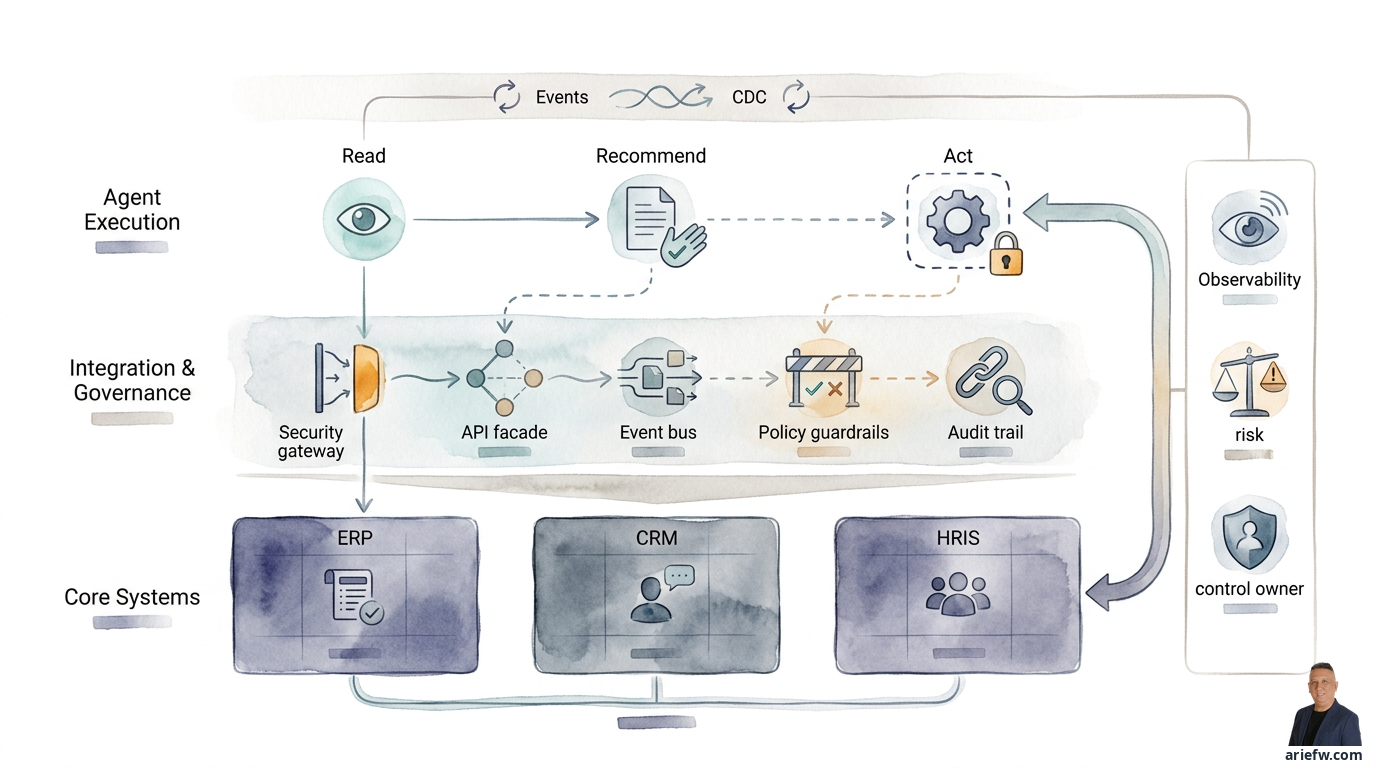
Imagine your finance team starts using an agent to help with the monthly book close. The agent can read invoices, match them against purchase orders, and flag discrepancies. But the moment it needs to know whether a goods receipt has been posted, whether a vendor is still active, or whether an invoice has already entered the dispute workflow, it has to ask the system that holds all that information. That's where the trouble begins.
ERP, CRM, HRIS, and other core systems are not just large databases that can be queried at will. They are where the official business state is stored and validated. Orders, invoices, customer data, employee status—it's all there. An agent cannot function well without understanding the current business state. Yet many companies find that their existing systems were never designed for this kind of interaction.
This isn't about AI models being insufficiently sophisticated or use cases being uninteresting. Many agentic AI programs slow down precisely because core systems are hard to access, slow, inconsistent, or unsafe for semi-autonomous interaction. The CIO sees it as an architecture problem. The COO sees it as a process design problem. The CFO and CHRO see it as a control and accountability problem.
Why core systems often become bottlenecks
Enterprise core systems are generally built for transaction standardization and control, not for the dynamic interaction that agents require. Several common obstacles emerge.
Real-time access is not always available. Many systems still rely on batch processing, periodic data replication, or slow point-to-point integrations. An agent could end up making decisions based on stale data. For analytical use cases, this might be acceptable. For operational use cases, it's dangerous.
APIs may exist, but they aren't necessarily usable for agentic workflows. Their scope is limited, documentation is weak, performance is unstable, or they are only suitable for traditional applications with highly structured interactions. An agent might need to call several endpoints in sequence, require policy validation mid-process, or need to pause and resume based on approvals. Core systems are not necessarily ready for these patterns.
Access controls are often too coarse. Access rights in core systems are designed for human roles, not for digital workers with narrow scopes. As a result, companies get trapped: the agent is given either too much access or none at all.
There is also the problem of business semantics scattered outside the systems. Real business rules don't just live in the ERP or CRM. Some reside in team spreadsheets, local SOPs, emails, knowledge bases, or undocumented operational habits. An agent that only connects to core systems without understanding this layer of rules will frequently get the context wrong.
The most sensible integration pattern: read, recommend, act
A common mistake is wanting to make an agent capable of executing transactions right away. A healthier approach is gradual. The read, recommend, act pattern is not just a technical roadmap. It's a way to manage risk, build trust, and mature the operating model.
Stage 1: Read — the agent understands the business state without changing it
In the early stage, the agent should focus on read-only access to core systems. Its goal is to understand transaction context, detect exceptions, summarize status, and provide insights or action priorities. This phase often delivers the fastest value because the risks are relatively lower.
A finance team could use an agent to read ledger data, reconciliation status, and exception history to flag entities or accounts at risk of a delayed close. A procurement team could use an agent to read intake requests, vendor status, contracts, and purchase history, then guide requesters to the correct purchasing path. Customer operations could prepare case summaries before a human agent handles a customer. HR operations could send proactive notifications about stalled onboarding.
The business value in this stage comes from reduced time spent searching for data, prioritized exceptions, and fewer manual handoffs. But read-only is not enough if the company wants to significantly change the economics of a process. Humans still need to move decisions into the system, create transactions, send follow-ups, and close the loop.
Stage 2: Recommend — the agent prepares actions, humans approve
In this stage, the agent doesn't just read. It starts preparing draft transactions, creating workflow requests, compiling action recommendations, or triggering next steps that still require human approval. This is often the sweet spot for many enterprise functions.
In accounts payable, an agent could detect an invoice mismatch, prepare a root cause analysis, and create a draft case resolution for an AP clerk to review. In sales operations, an agent prepares the next-best action for an account manager or drafts an opportunity update. In HRIS, an agent prepares a draft employee data change, but approval remains with HR or the line manager. In IT operations, an agent gathers telemetry, suggests a root cause, and prepares a runbook action, but the engineer still approves the remediation.
Humans retain the control points. Recommendation quality can be evaluated. The organization learns where the agent truly helps versus where it is still frequently wrong.
But there is a trade-off. If the approval design is poor, the company simply moves the bottleneck from searching for data to approving agent drafts. Approvals must be designed with discipline: only for actions that truly need them, with sufficient context, and with clear SLAs.
Stage 3: Act — the agent performs limited actions within clear boundaries
The most mature stage is when the agent can act directly within core systems. The keyword is limited. This doesn't mean the agent is free to create any transaction. What's more realistic is bounded autonomy: actions are only for specific scenarios, with policies and thresholds in place, full logging, rollback or compensating actions available, and a mechanism to halt if behavior deviates.
Customer service could give an agent the authority to update ticket status, send standard communications, or process non-material order changes if they meet policy. Collections could give an agent the authority to send automated follow-ups or create promise-to-pay reminders. IT operations could give an agent the authority to perform low-risk remediation like restarting a specific service. Procurement could give an agent the authority to create draft POs for highly standardized categories.
Don't force the act stage for domains that touch material financial controls, have high legal or regulatory impact, involve unstable data, or lack a clear rollback mechanism. Posting material journal entries, changing sensitive vendor master data, making employee compensation decisions, approving credit, or changing high-value customer policies should keep a human-in-the-loop for a longer time.
Agents shouldn't wait to be asked
Many early agent implementations are still passive: the agent only works when someone asks a question or presses a button. This is useful for a copilot. But for an agentic operating model, a more powerful pattern is for the agent to respond to business changes as they happen.
An agent works much better if it receives signals like order changed, ticket escalated, invoice overdue, payment failed, inventory exception, employee onboarding delayed, or shipment at risk. With events like these, the agent doesn't need to constantly poll the system or wait for a human to notice a problem.
Manual polling or periodic queries burden core systems, create latency, and often cause the agent to react too late. Event-driven design allows the agent to work closer to the real operational rhythm.
In supply chain, when inventory drops below a threshold or a shipment is delayed, an event is sent to a bus. An agent control tower immediately assesses the impact on customer orders and prepares mitigation options. In customer operations, when a ticket escalates to high priority, an event triggers an agent to compile a case summary and escalation recommendation. In finance, when an invoice passes its due date, an event triggers a collections agent to start follow-up actions.
Two patterns that are often relevant are the event bus, where enterprise systems publish operational events to a shared platform and agents subscribe to relevant events, and Change Data Capture (CDC), which helps capture changes to transactional data if the core system doesn't have good native events.
Event-driven design also improves observability. Every trigger, decision, and action can be traced as a sequence of events: an event occurs, an agent is triggered, additional data is fetched, a policy is checked, an action is taken or escalated. For operations, risk, and audit, this is far healthier than an agent working silently in the background.
Of course, there are trade-offs. Event-driven architecture adds requirements for event standardization, idempotency management, handling duplicate or late events, and disciplined ownership across systems. If the company's integration foundation is still very weak, start with a domain where the events are clearest and most valuable.
Don't wait for all systems to be perfect
One reason companies move slowly is the assumption that all core systems must be modernized first before agents can be used. This is unrealistic. A more appropriate approach is selective modernization based on the capabilities most needed by priority use cases.
The more useful question isn't "which system should be replaced first?" but "what capabilities are most frequently needed by priority agentic use cases?" If your priority is finance close, the most important capabilities might be access to close and reconciliation status, reading journal exceptions, creating issue workflows, and accessing an evidence repository. If your priority is customer operations, the key capabilities might be reading customer history, reading and updating cases, checking order status, and sending standard communications.
For legacy systems that are hard to touch, the most effective pattern is to build an API facade or service layer in front of them. The goal is to simplify the complexity of the old system, normalize schemas, limit the actions an agent can take, and avoid dependence on UIs or direct database access. An agent should not rely on screen scraping, direct queries to core tables, or hidden logic understood by only a few people. An API facade also helps governance because the company can decide that agents may only interact through validated, policy-enforced, logged services that can be shut down if necessary.
Many integration programs consider themselves finished when an endpoint is created. For an agentic enterprise, that's not enough. What needs to be measured is whether the integration is truly fit for operations. Data access time for priority use cases, API reliability and error rates, the completeness of available events, the number of workflows an agent can safely execute, and the frequency of fallback to humans due to integration failures are more relevant metrics. If an API exists but frequently times out, schemas change without governance, or events are inconsistent, the business will not trust the agent.
Implications for operating model and governance
Connecting agents to core systems is not just a middleware project. Once an agent touches ERP, CRM, or HRIS, several governance implications arise immediately.
Every connection to a core system must have a business owner and a technical owner. It's not enough for "the integration team to handle it." It must be clear who owns the business capability being opened up to the agent.
The boundaries of read, recommend, and act must be formal. Don't let each team determine its own level of autonomy without a shared framework. This will lead to inconsistent controls.
Audit trails must be cross-system. The company must be able to explain not just what the agent did, but what business state it read and what changes it made in the core systems.
Workforce impact must be considered from the start. Once agents can read and act in core systems, human work will shift. Operations teams will no longer just enter data or chase statuses; they will spend more time handling exceptions, approvals, and policy improvements.
Don't let agent integration grow wild per function. If each function builds its own connection to the ERP or CRM without common standards, the company will create new technical debt in the form of agent integration sprawl.
Reflective questions
For the CIO, the question is whether the company's digital core is truly ready to be an execution platform for agents, or whether it remains a record-keeping system that is difficult to access securely.
For the COO, the question is in which processes the biggest bottleneck is not actually the people, but the delay in accessing business state from core systems.
For the CHRO, if agents start reading and triggering workflows in the HRIS, which roles will shift from administration to oversight and exception management.
For the transformation leader, does the roadmap start with high-value use cases that have realistic integration capabilities, or is it still stuck between impressive AI demos and core systems that are not ready to be touched?
If the answers to these questions are still unclear, the next priority is not to add new agents. The priority is to clarify the safe path between agents and core systems. That is where the agentic enterprise truly begins to become real.